
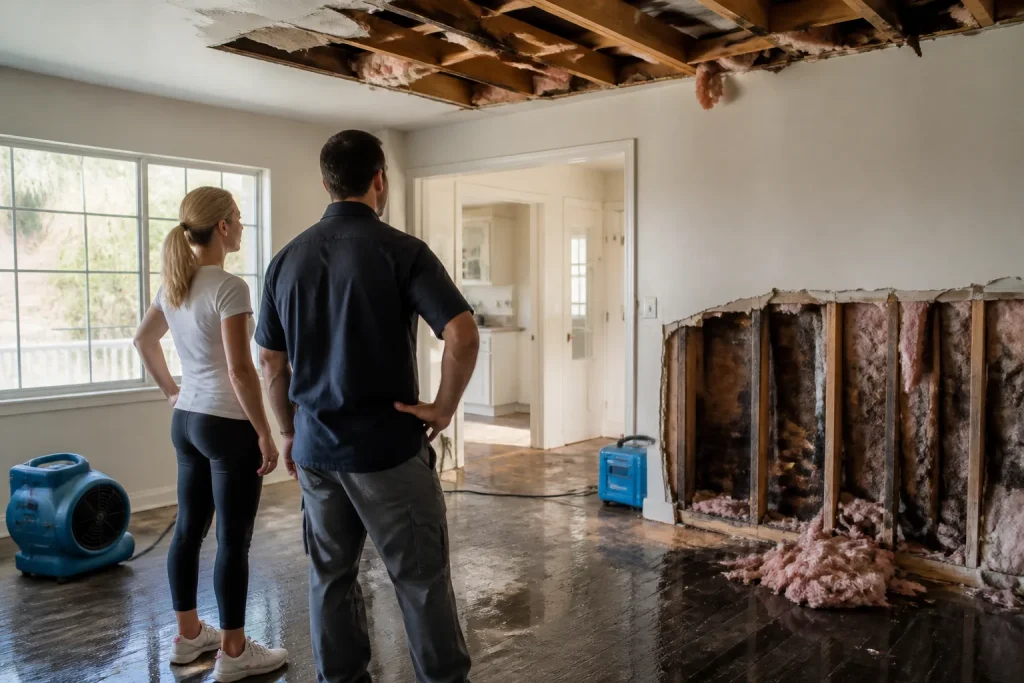
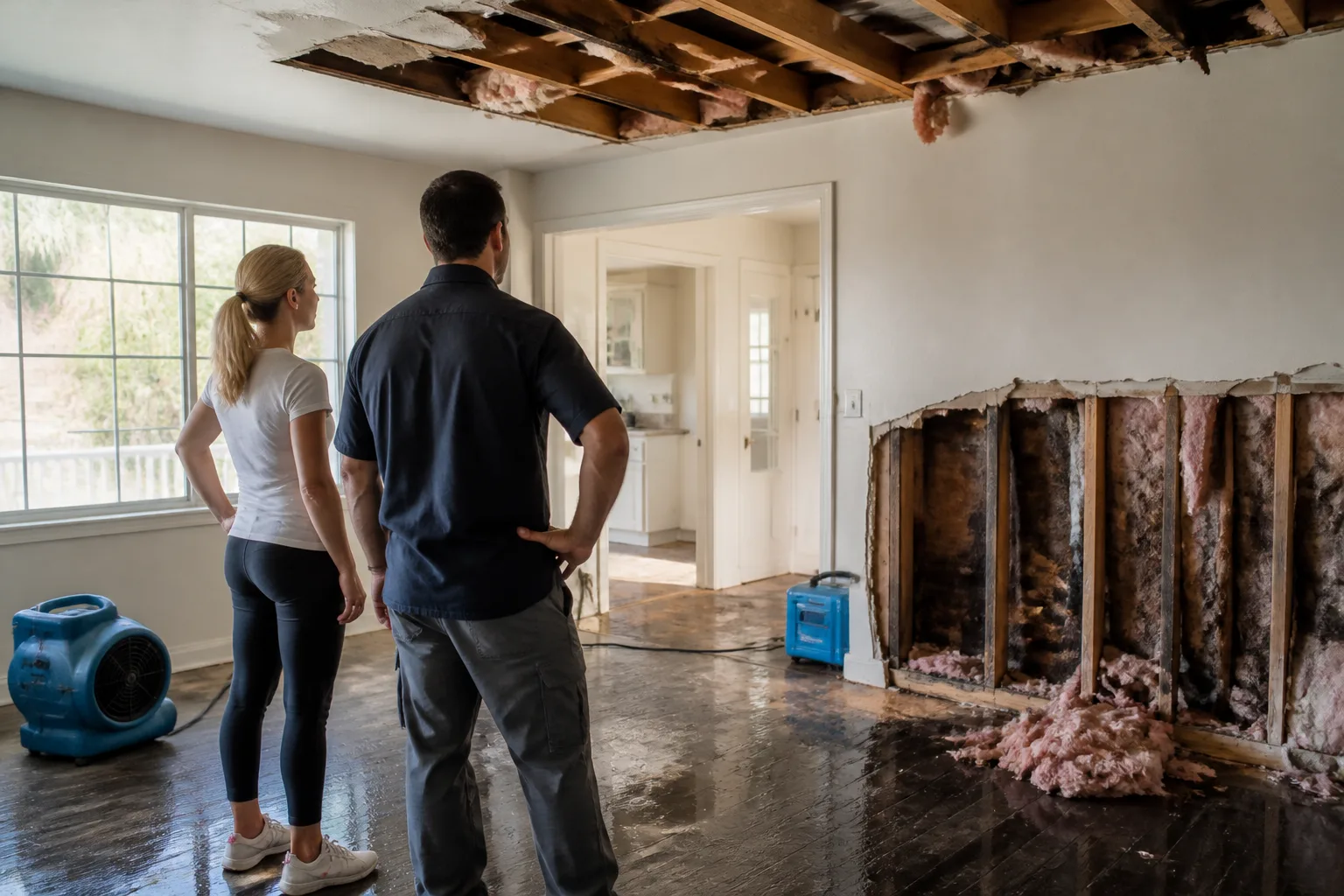
Water Damage Restoration: Repair or Replace? How Los Angeles Homeowners Decide
Most water-damaged materials in Los Angeles homes can be dried and restored if the response is fast enough and the moisture is properly extracted. Replacement is necessary when contamination levels are high, structural integrity is compromised, or moisture content remains above salvageable thresholds after professional drying. The real problem: too many contractors make this call based on what’s profitable, not what’s technically appropriate. Here’s how to tell the difference.
If you’re staring at wet drywall right now and don’t want to become a moisture-reading expert before dinner, call us at (361) 317-7269. We answer live, 24/7.
Why the Repair-or-Replace Decision Gets Rigged
A contractor who makes more money replacing drywall than drying it in place has a built-in reason to call your walls unsalvageable. The moisture readings don’t lie – the question is whether you’re allowed to see them.
We’ve been called into Los Angeles homes where the previous crew had already started ripping out perfectly salvageable kitchen cabinets before taking a single moisture reading. The homeowner paid for replacement that drying would have handled. The cabinets weren’t the problem; the business model was.
The IICRC S500 standard, which governs professional water damage restoration, sets specific moisture content thresholds for different materials. Drywall is generally considered salvageable when moisture content stays below 16% and drying begins within 24 to 48 hours. Hardwood flooring has more complex criteria based on species, thickness, and whether cupping has set in. These aren’t opinions. They’re measurable, documentable numbers.
At Keegan Water Damage Restoration home, we put those numbers in writing before any demolition starts. Every Keegan job runs to The Garrison Standard: written price before work begins, background-checked uniformed technicians, and the Done Right Promise backing every repair. If a crew won’t show you their moisture readings, they’re not following a standard. They’re following an incentive.
Moisture Thresholds That Actually Determine Salvageability
Here’s what the readings should look like on a legitimate report. These are the IICRC S500 benchmarks we use on every Los Angeles job:
- Drywall (paper-faced): Salvageable below 16% moisture content with rapid structural drying. Above 16% with visible swelling or mold growth, replacement is indicated.
- Hardwood flooring: Salvageable if moisture content returns to within 4% of the subfloor reading and cupping hasn’t progressed to permanent deformation. Oak and maple respond differently; engineered hardwood has less recovery potential than solid plank.
- Cabinetry (particleboard core): Often non-salvageable once moisture exceeds 20% because particleboard delaminates and loses structural integrity. Solid wood frames may be saved even when boxes need replacement.
- Subfloor (plywood/OSB): Must reach 12% or lower before flooring is reinstalled. Trapped moisture here causes the most expensive callbacks.
These numbers change based on ambient humidity. A reading that means replacement in humid Houston might mean salvage in dry Palm Springs. Los Angeles sits in a middle zone – coastal moisture in Venice or San Pedro, drier conditions in the Valley – and your technician should be adjusting targets accordingly, not applying a national average.
We document every reading with photos, time stamps, and equipment logs formatted to support your insurance claim. The local pros run Dri-Eaz and Phoenix dehumidifiers with psychrometric monitoring, so we know exactly when a material has reached its drying goal versus when someone just got tired of waiting.
How Los Angeles Housing Age Changes the Math
Los Angeles has a housing stock problem that most contractors ignore: a 1920s Spanish Colonial in Los Feliz and a 2005 tract home in Studio City don’t respond to water the same way, but they get the same flat recommendation from crews who’d rather replace everything.
Pre-1980 homes often have plaster and lath instead of paper-faced drywall. Plaster is more moisture-resistant and more salvageable than modern drywall when drying starts quickly. The lime content in old plaster inhibits mold growth. We’ve dried in place plaster walls in Los Angeles homes that another contractor had marked for full gutting. The key is getting air movement into the wall cavity with Injectidry or XPOWER systems, not assuming the wall is done because it’s old.
Post-1980 paper-faced drywall is the opposite. The paper facing is mold food once wet. But even here, “mold food” doesn’t mean automatic replacement. If moisture content drops below 16% within 48 hours and antimicrobial treatment is applied, the drywall stays. The contractor who skips aggressive drying and goes straight to “it’s gotta come out” is saving themselves equipment time at your expense.
Then there’s the mid-century weirdness: Los Angeles has thousands of homes with drywall over plaster, or multiple renovation layers. Moisture gets trapped between layers. A surface reading looks fine while the cavity stays wet. This is where experience with local construction matters. We pulled one out of a garage over in Eagle Rock last month where three layers of finishing had created a moisture sandwich the homeowner didn’t know existed until we started probing with extended-depth meters.
When Replacement Is Actually the Smarter Call
Not every wet wall should be saved. There are legitimate scenarios where replacement is faster, cheaper, and safer than drying in place:
- Category 3 contamination (sewage or floodwater): IICRC standards require removal of porous materials regardless of moisture content. Drying in place creates liability for the contractor and health risk for the homeowner. If your water source was a backed-up sewer line or street flooding, replacement isn’t negotiable.
- Structural compromise: Water-damaged particleboard subfloors, delaminated plywood, or sagging ceiling drywall can’t be dried back to structural integrity. The material is permanently weakened.
- Hidden mold established before discovery: If the leak ran for weeks behind a wall, mold colonization may be advanced enough that even successful drying leaves a problem. This is common in Los Angeles slab foundations where slow leaks travel before surfacing.
- Cost crossover: Sometimes extended drying with specialized equipment costs more than replacement. A legitimate contractor will show you that math, not just default to demolition.
The red flag is a contractor who recommends replacement without categorizing your water source, taking readings, or explaining the specific failure mode. That’s not technical judgment. That’s sales.
Reading the Moisture Report Yourself
You don’t need to become a thermographer to spot a thin report. Here’s what a legitimate moisture documentation should include on any Los Angeles water damage restoration job:
- Baseline readings from unaffected areas. You can’t know what’s abnormal without knowing what’s normal for that specific home. A report that skips this is guessing.
- Multiple depths per location. Surface readings with a pinless meter tell you almost nothing about cavity moisture. Pin meters at multiple depths, or infrared imaging showing temperature differentials, are minimum standards.
- Time-stamped progression. Daily readings showing downward moisture trends prove the drying plan is working. Flat or rising readings mean equipment or technique needs adjustment.
- Equipment placement map. Where each dehumidifier, air mover, and injection dry system is located, with CFM ratings and psychrometric targets.
- Final clearance readings. Documentation that materials reached their dry standard before equipment removal.
A two-page report with three readings and a bill is not documentation. It’s a receipt. Insurance adjusters know the difference, and so should you.
At Water Damage Restoration in Los Angeles, we format every job file to support your claim. Photo documentation, equipment logs, moisture maps, and the written scope of loss before work starts. When replacement is necessary, the documentation justifies it. When drying succeeds, the documentation proves it.
Insurance Realities: How the Choice Affects Your Claim
Replacement generates higher claim value, which sounds like a win. It’s not always. Here’s what Los Angeles homeowners need to understand:
Higher claim values can trigger rate increases or non-renewal, especially in California’s tightening insurance market. A documented, successful drying job with professional equipment keeps your claim lower while restoring your home. The key word is documented. Aggressive drying without moisture logs won’t satisfy an adjuster and may result in denied coverage for subsequent mold issues.
Direct insurance billing helps, but only when the documentation supports the billed work. We coordinate directly with adjusters on Los Angeles claims because our reports are built to their format requirements from day one. The homeowner who chooses replacement for convenience, without understanding the claim impact, often pays more over the five-year horizon than the homeowner who invested in proper drying.
When replacement is truly necessary – Category 3 loss, structural failure – the same documentation protects you. A thin report on a high-dollar replacement claim invites scrutiny and delay. A thick report on any claim gets paid faster.
When to Call a Professional
If water is actively spreading, if you can’t identify the source, if the water might be contaminated, or if more than a small area is affected, you need a crew on site. Moisture moves in ways that aren’t visible. By the time you see staining on a ceiling, the real damage is often three rooms away in the crawl space or wall cavity.
We answer live at (361) 317-7269, every hour of every day. A real person, no phone tree. If you’re in Los Angeles and need water damage restoration, we’ll give you a written price before any work starts, show you every moisture reading, and back the repair with our Done Right Promise.
Related services: Fire Damage Restoration in Los Angeles | Mold Remediation in Los Angeles
The Bottom Line
The repair-or-replace decision should come from moisture readings, material science, and the specific conditions of your Los Angeles home – not from a contractor’s profit margin. Ask for the numbers. Ask for the documentation. Ask why the recommendation is what it is. A crew running to a real standard will welcome those questions.
Key takeaways:
- Most materials are salvageable if drying starts fast and moisture thresholds are monitored
- Pre-1980 Los Angeles homes with plaster often have better salvage potential than modern drywall
- Category 3 contamination and structural failure are legitimate replacement triggers
- Documentation protects your insurance claim and proves the work was done right
- Get the moisture report in writing before any demolition starts
If you’re in Los Angeles and facing water damage, Keegan Water Damage Restoration offers free estimates. Call (361) 317-7269 and we’ll put the price in writing before any work begins, back every repair with our Done Right Promise, and show you every reading that drives the repair-or-replace call.
Frequently Asked Questions
Ask to see the moisture readings that support the recommendation. A legitimate technician will show you specific numbers, explain the IICRC thresholds for each material, and document why drying won’t work. If they can’t or won’t, get a second opinion before any demolition starts. Call (361) 317-7269 for a free second look – estimates cost nothing.
Most policies cover both when properly documented. Insurance companies actually prefer well-documented drying because it controls claim costs. The key is professional moisture mapping and equipment logs that prove the work was necessary and effective. We format every Los Angeles job file specifically for adjuster review. Call (361) 317-7269 and we’ll coordinate directly with your insurance.
The decision window is 24 to 48 hours for most materials. After that, mold colonization begins and structural damage progresses, making replacement more likely. This is why we answer live 24/7 and dispatch immediately for Los Angeles water damage calls. The faster we start extraction and drying, the more options you have. Call (361) 317-7269 – we’re already staffed for emergency response.
Small, clean water spills on hard surfaces, yes. Anything affecting drywall, flooring, or wall cavities, no. Home fans and wet-dry vacs don’t move enough air or remove enough moisture to hit IICRC drying standards. Hidden moisture causes mold, structural rot, and insurance denials for subsequent damage. For anything beyond a minor spill, professional extraction with Dri-Eaz or Phoenix dehumidification equipment is the only way to document that drying was done to standard. Call (361) 317-7269 for an assessment – estimates are free.
Written by the team at Keegan Water Damage Restoration.
Need Damage Restoration Help?
Call Keegan Water Damage Restoration - licensed & insured, here with fast after-hours help in Los Angeles.
(361) 317-7269