
5 Mistakes to Avoid With Water Damage Restoration
The five costliest mistakes in water damage restoration happen in the first two hours, before any contractor arrives. Most homeowners focus on finding the right company, but the real damage to your claim and your home happens while you’re still standing in wet socks. Here’s what to do, what to avoid, and when to call Keegan Water Damage Restoration at (361) 317-7269.
We’ve been part of the Garrison Partners family, running water, fire, and mold jobs across Los Angeles. The jobs that go sideways rarely fail because of bad technique. They fail because the homeowner made one of these five decisions before we ever pulled up.
Mistake 1: Starting Cleanup Before You Document
Your first instinct is to grab towels and start hauling out soaked carpet. That instinct costs people thousands.
Insurance adjusters in Los Angeles see disputed water claims every day, and the ones that get reduced or denied almost always share the same problem: no timestamped, unaltered photos from the immediate aftermath. Without visible water lines on drywall, standing water depth against baseboards, and clear shots of every affected material, the adjuster can argue the damage was pre-existing or less extensive than claimed.
Here’s what to photograph before touching anything:
- Wide shots of each room showing water spread and source point
- Close-ups of water lines on walls, furniture legs, and appliances
- The underside of cabinets and any visible plumbing
- Your HVAC unit and electrical panels if water approached them
- A timestamp method: hold a phone showing the time, or enable location tagging
Then, and only then, start removing what you safely can. In our experience, the homeowner who spends ten minutes on documentation saves ten hours of claim negotiation later. We format every Keegan job with photo documentation that supports your insurance claim from day one, but we can’t photograph what you already threw out.
When to call a pro: If water has reached wall cavities, electrical outlets, or your subfloor, stop and call. The documentation matters, but so does speed. We answer live 24/7, and we’ll document everything properly on arrival.
Mistake 2: Calling Your Insurance Company Before You Understand the Scope
This one feels counterintuitive. Isn’t that what you’re supposed to do?
Here’s the problem. That first call to your insurance company creates a preliminary claim record. The representative asks what happened, you describe it in plain language, and they note a dollar range based on your description. That number becomes an anchor. Every estimate after that gets measured against it, and adjusters are trained to defend their first position.
We’ve seen this in Los Angeles repeatedly. A homeowner calls and says, “My washing machine leaked, the laundry room is flooded.” The adjuster hears “laundry room” and mentally caps the scope. Three days later, we find the water traveled through the wall into the hallway closet, soaked the bedroom carpet pad, and wicked two feet up the drywall in the adjoining bathroom. But the preliminary claim is already filed as “laundry room only,” and now you’re fighting an uphill battle to expand it.
The better sequence:
- Stop the source if you safely can
- Document everything (see Mistake 1)
- Call a restoration company for a proper scope of loss
- With that scope in hand, call your insurance company
A scope of loss is the trade term for a written, line-item breakdown of every affected material, the drying equipment needed, and the labor to restore it. At Keegan, we put this in writing before any work starts. You can read it, understand it, and present it to your adjuster as a factual baseline rather than a guess.
We also coordinate directly with adjusters on every Los Angeles job. Our documentation is formatted to support your claim, and we speak the same language they do: IICRC categories of water damage, psychrometric readings, and equipment calculations by cubic foot.
Mistake 3: Letting Urgency Override the Written Estimate
Water is actively destroying your home. You’re stressed, possibly in shock, and a contractor says, “We need to start now or mold will grow in 48 hours.” You sign whatever’s put in front of you.
This is where the industry earns its reputation problem. Some contractors use urgency to bypass the pricing conversation entirely. The specific phrases to watch for:
- “Let’s just get started, we’ll figure out the price after mitigation”
- “I can’t give you a real number until we open the walls”
- “Everyone charges about the same, the important thing is speed”
- “Sign this authorization, the insurance will handle it”
Here’s what to say instead: “I need a written price before any work starts. What can you give me right now?”
A legitimate contractor can always provide a written estimate for the initial emergency scope: extraction, controlled demolition if needed, and the drying setup with equipment rates. The full rebuild estimate comes later, after the structure is dry, but the emergency work should never be open-ended.
The Garrison Standard exists because of this exact scenario. Every Keegan technician arrives with a tablet, photographs the loss, builds a line-item scope, and presents it for your signature before equipment touches your floor. The price never moves at the door. If a contractor won’t do this, call someone else. Even with water spreading, ten minutes of clarity saves weeks of dispute.
Our water damage restoration in Los Angeles runs to this standard on every job, no exceptions.
Mistake 4: Hiring the Wrong Contractor (Yes, It’s Only Number Four)
Most articles lead with this. They’re not wrong, but they’re not complete.
By the time you’re evaluating contractors, the first three mistakes may already be baked in. That said, here’s what actually matters in a water damage restoration company in Los Angeles:
- Background-checked, uniformed technicians – not day laborers in personal vehicles
- Professional-grade equipment – LGR dehumidifiers from Dri-Eaz or Phoenix, air movers from XPOWER or B-Air, and wall-cavity drying systems like Injectidry for trapped moisture
- IICRC-certified work to industry standards, not “we’ve been doing this for years”
- Written guarantee with real terms – ours is the Done Right Promise
- Direct insurance coordination with photo documentation formatted for adjusters
We pulled one out of a garage over in Silver Lake last month where the previous contractor had set two box fans and a dehumidifier from a hardware store, then disappeared for four days. The homeowner called us when the drywall started growing visible mold. The “cheap” guy cost her an extra $4,200 in mold remediation that proper drying would have prevented.
Check reviews for specific mentions: did they show up inside the window? Was the price the same at the end? Did they document for insurance? Generic five-star ratings without detail are less useful than one detailed review mentioning these specifics.
Mistake 5: Assuming “Dry to the Touch” Means Dry
This is the mistake that voids guarantees and creates callbacks.
Your wall feels dry. The carpet is dry. You want the equipment out of your house – it’s loud, it’s hot, and your life is disrupted. You tell the contractor to pull it, or you pull it yourself if it’s your equipment.
Structural drying doesn’t work that way. Surface feel and moisture content are different measurements entirely. Wood framing is considered dry at roughly 12-16% moisture content, depending on the species and local humidity. Drywall should read below 1% above baseline on a moisture meter. “Dry to the touch” can occur at 30% moisture content – more than enough to support mold growth inside the wall cavity where you can’t see it.
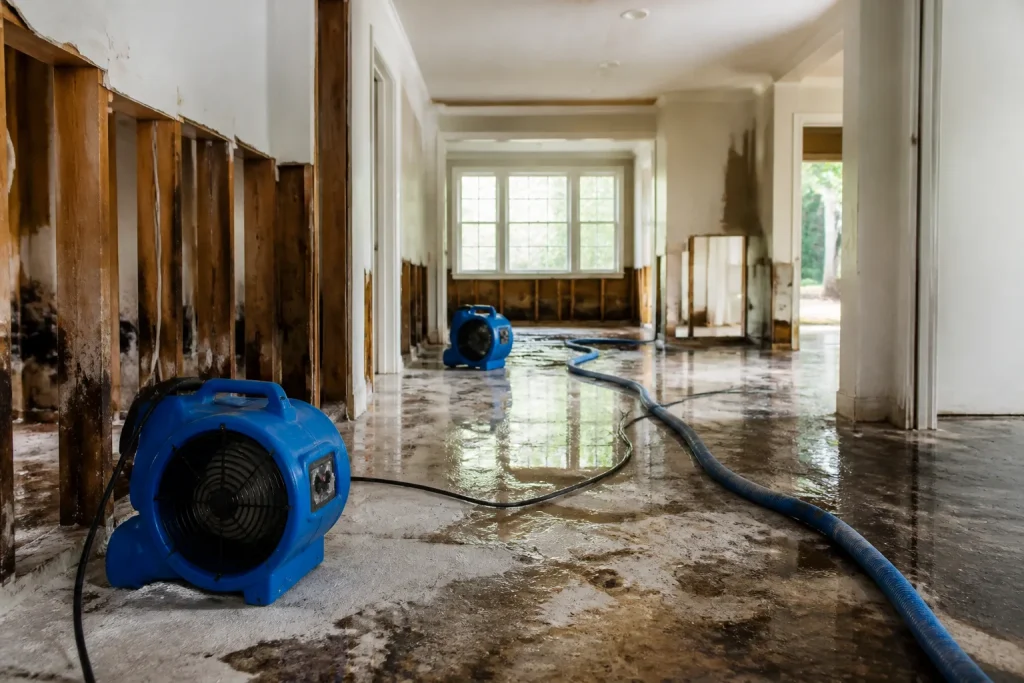
We use moisture meters, thermal imaging, and psychrometric calculations (the science of air temperature, humidity, and vapor pressure) to determine when drying is complete. Our Dri-Eaz and Phoenix dehumidifiers are sized to the cubic footage of the affected space, and we log readings daily. The equipment stays until the numbers say it’s done, not until it feels right.
Pulling equipment early also voids most contractor guarantees, including ours. The Done Right Promise requires that we control the drying process from start to finish. If you remove equipment against our recommendation, we can’t stand behind the result – and no reputable contractor can.
In Los Angeles, where humidity spikes during Santa Ana wind shifts and winter rain events, this matters more than in drier climates. We’ve seen properly dried structures re-wick moisture from humid air when the envelope wasn’t fully sealed.
Related services in Los Angeles: If your water damage has already progressed to mold, our mold remediation in Los Angeles follows the same documentation and written-price standards. For fire-related water damage from suppression systems, see our fire damage restoration in Los Angeles.
The Bottom Line
The homeowners who come out ahead aren’t the ones who found the cheapest bid. They’re the ones who documented first, understood their scope before calling insurance, held the line on written pricing, hired a disciplined crew, and let the drying run to completion.
These five mistakes share a common thread: they all happen because water damage feels like an emergency, and emergencies override good judgment. The antidote is a standard you can hold every decision against. At Keegan, that’s The Garrison Standard: show up inside the window, price in writing, do it by the book, leave the site clean, stand behind the work for a full year.
If you’re in Los Angeles and dealing with water damage right now, call us at (361) 317-7269. A live person answers 24/7, we’ll give you a free estimate with a written scope before any work starts, and every repair is backed by our Done Right Promise.
Frequently Asked Questions
Emergency extraction and equipment setup happens same day. The drying phase usually runs 3-5 days for clean water losses, longer for gray or black water, or if we need to dry inside wall cavities with Injectidry systems. Rebuild timing depends on material availability and scope. Call (361) 317-7269 for a timeline specific to your loss – estimates are free.
Most homeowner policies cover sudden, accidental water damage from burst pipes or appliance failures. They typically exclude slow leaks, groundwater intrusion, or maintenance-related issues. The key is documentation: timestamped photos, a proper scope of loss, and direct adjuster coordination. We format every Keegan job to support your claim. Call (361) 317-7269 and we can review your situation.
Consumer fans move air but don’t remove moisture from the air – they just push wet air around. Without LGR dehumidifiers sized to the space, moisture reabsorbs into materials and mold risk extends for weeks. For anything beyond a small spill on hard surfaces, professional extraction and drying equipment pays for itself in prevented secondary damage. Call (361) 317-7269 if you’re unsure about your situation.
Stop the source if you safely can, shut off electricity to affected areas if water is near outlets, take timestamped photos of everything before moving anything, then call a restoration company. Don’t call your insurance company first – get a scope of loss so you have factual numbers for that conversation. Keegan answers live 24/7 at (361) 317-7269.
Written by the team at Keegan Water Damage Restoration.
Need Damage Restoration Help?
Call Keegan Water Damage Restoration - licensed & insured, here with fast after-hours help in Los Angeles.
(361) 317-7269