
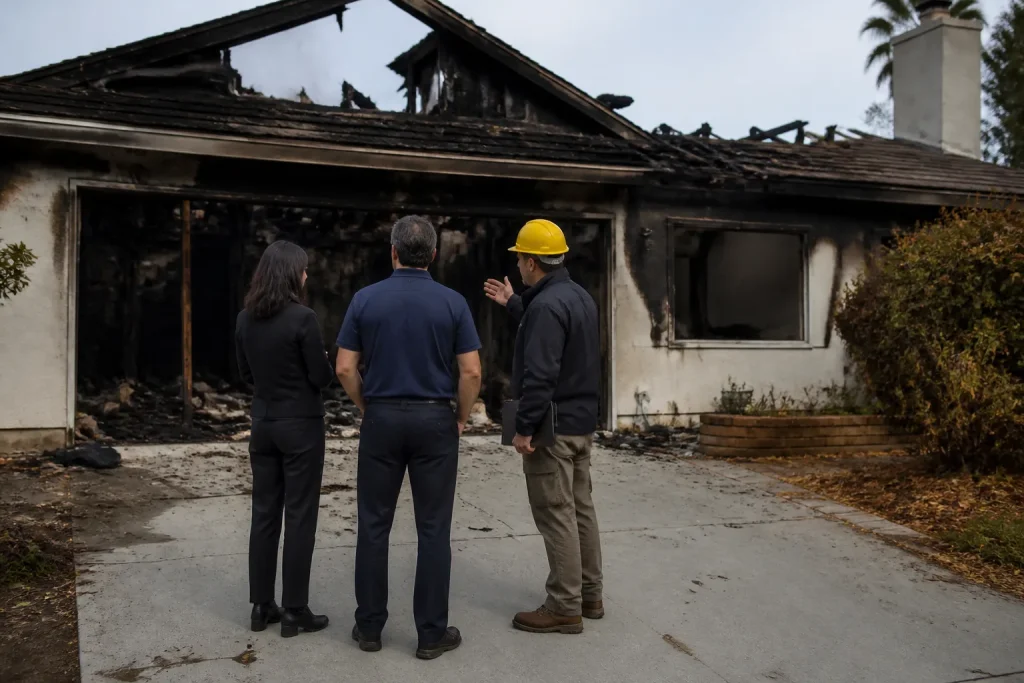
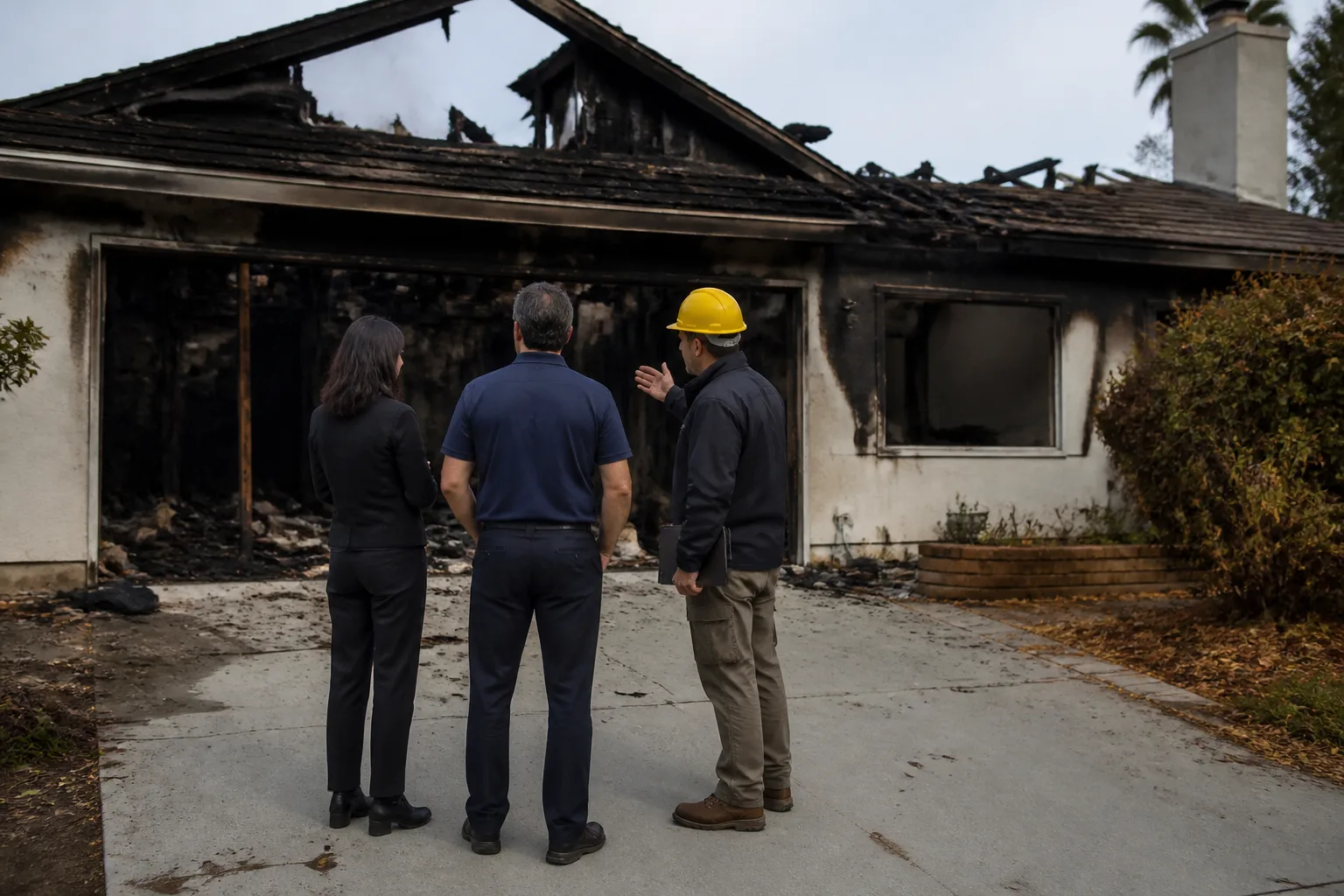
Fire Damage Restoration: Repair or Replace? How Los Angeles Homeowners Decide
Most fire damage in Los Angeles homes is repaired, not replaced, but only when the decision is based on smoke penetration depth rather than what you can see with your eyes. The charred area is usually the smallest part of the job. The real cost driver, and the factor that determines whether a material can be saved, is how far smoke and acidic soot have traveled into wall cavities, HVAC systems, and porous surfaces. If you’d rather have a trained technician assess this with moisture meters, smoke residue tests, and thermal imaging rather than guessing, call us at (361) 317-7269.
The part of your home that burned is the easy call. The part that looks fine but smells like smoke is where the real repair-or-replace decision gets made, and most homeowners are making it wrong. We’ve been called to jobs in Silver Lake where the kitchen fire was contained to a single pan, but six months later the cabinets two rooms away still reeked because no one checked the HVAC return path. The visible char was maybe two square feet. The smoke migration covered forty.
Why Smoke Penetration Depth Matters More Than Burn Area
Fire produces three distinct types of residue, and each behaves differently in Los Angeles’s dry climate. Dry smoke from fast-burning, high-heat fires leaves a powdery residue that sits on surfaces. Wet smoke from slow, smoldering fires, common in upholstery and electrical fires, is sticky and acidic. Protein residue from kitchen fires is nearly invisible but carries an intense, persistent odor. The type of smoke determines how far it travels and what it destroys.
We evaluate smoke penetration using three measurements:
- Surface residue depth: Soot that wipes away with a dry sponge may only need cleaning. Soot that has bonded to paint or varnish requires chemical restoration or replacement.
- Substrate absorption: Porous materials like unfinished wood, concrete, and unsealed grout absorb smoke particles. In our experience, if smoke odor is detectable deeper than 1/8 inch into soft pine framing in Los Angeles homes, replacement is more reliable than restoration.
- Cavity migration: Smoke follows the path of least resistance, which in Los Angeles’s older homes often means balloon framing cavities, shared walls between units, and the space behind stucco exteriors. We use Injectidry systems and thermal imaging to trace this migration without tearing out walls unnecessarily.
The IICRC S730 standard for fire and smoke damage restoration provides the framework we follow, but the field decision always comes down to this question: can we remove the contamination without destroying the material, and if we restore it, will odor return in six months? If the answer to either part is no, we recommend replacement and document why for your insurance claim.
Materials That Should Almost Always Be Replaced After Fire
Some materials are technically restorable but never worth the cost or risk. In Los Angeles, where labor rates run high and insurance adjusters scrutinize line items, we flag these categories upfront so homeowners don’t pay for restoration that fails later.
Insulation: Fiberglass batts, cellulose, and spray foam all trap smoke particles permanently. Once smoke enters an insulated wall cavity, the insulation is compromised. We’ve opened walls in Mid-City where the drywall looked salvageable but the insulation behind it held enough odor to contaminate the entire room. Replacement is the only option.
Vapor barriers: Polyethylene sheeting and kraft-faced insulation paper absorb both smoke and the acidic byproducts of combustion. They cannot be cleaned in place. In Los Angeles’s mixed climate, where vapor barriers are critical for moisture management, compromised barriers lead to secondary damage.
Paper-faced drywall: The paper facing is highly absorbent. Once smoke permeates it, the drywall board itself may be structurally sound, but the facing will off-gas odor indefinitely. We typically recommend replacing any paper-faced drywall within the smoke migration zone, even when the gypsum core tests clean.
HVAC flex duct: The corrugated interior traps particles. Cleaning is possible but rarely cost-effective, and residual odor will distribute through the entire system. Rigid metal duct can often be restored with mechanical cleaning and encapsulation.
LA-Specific Factors That Hide Fire Damage
Los Angeles architecture creates unique assessment challenges that out-of-town adjusters and less experienced contractors often miss.
Stucco exterior walls: Hard-coat stucco over wire lath creates a shell that hides smoke migration into wall cavities. The stucco itself is usually restorable with specialized cleaning, but the framing, insulation, and interior drywall behind it may be heavily contaminated. We use borescopes and moisture meters to inspect cavities without destructive testing. Last year we assessed a fire in a 1940s Los Feliz duplex where the stucco showed no visible damage, but smoke had traveled horizontally through the wall cavity into an adjacent unit’s bedroom.
Spanish tile roofs: The curved clay tiles and heavy sub-decking common in Los Angeles’s Spanish Revival homes can conceal char and heat damage to the roof structure. Ground-level inspection misses this. We document sub-deck condition with photos from the attic space, and when we find charred plywood or compromised rafters, we specify replacement with full photographic evidence for the adjuster.
Shared walls in multi-unit buildings: Los Angeles’s density means many fire damage calls involve condos, townhomes, or apartments. Smoke travels through party walls, and the damage in the neighboring unit may be worse than in the unit where the fire started. We coordinate with building management and adjacent owners, documenting all affected spaces to prevent claim disputes later.
Insurance Documentation: Restoration vs. Replacement Claims
The burden of proof is higher for restoration line items than for replacement. Insurance adjusters know that replacement is definitive, while restoration carries risk of callback and secondary claim. To support restoration recommendations, we document:
- Pre-cleaning and post-cleaning photos with standardized lighting
- Smoke residue test results showing contamination levels
- Moisture readings demonstrating that materials are dry and stable
- Written scope specifying the restoration method, equipment, and expected outcome
For replacement items, we provide:
- Evidence of irreversible contamination or structural compromise
- Like-kind replacement specifications
- Code upgrade requirements if applicable
Every job we run at Fire Damage Restoration in Los Angeles is documented to this standard. The photos, readings, and written scope go to your adjuster in a format that matches what they’re used to seeing from RIA-certified firms. This reduces back-and-forth and speeds claim resolution.
The written price we provide before any work starts includes line items coded as restoration or replacement, with the documentation supporting each. If an adjuster questions a line item, we have the evidence ready. This is part of The Garrison Standard: price in writing, do it by the book, stand behind the work.
Odor Elimination: Why the Wrong Method Wastes Money
Smoke odor persists when particles remain trapped in porous materials or when the odor has chemically bonded to surfaces. Two primary methods exist, and using the wrong one is a common mistake we see in Los Angeles.
Ozone treatment works by oxidizing odor molecules. It’s effective for organic odors in unoccupied spaces, but ozone degrades rubber, certain plastics, and some textiles. We use it selectively, never with occupants present, and only when the odor source is primarily airborne contamination in a sealed environment.
Thermal fogging uses a heated petroleum-based or water-based deodorizer that penetrates materials similarly to how smoke did. It’s more appropriate for protein residues and deeply embedded odors in porous materials. The fog follows the same paths the smoke took, neutralizing odor at the source.
The wrong choice: a contractor who uses ozone on protein residue, or thermal fogging without first removing the source contamination. We’ve been called to correct both scenarios in Los Angeles homes where the homeowner paid for treatment that didn’t last. Our approach follows IICRC protocol: source removal first, then deodorization method matched to the residue type, then verification with odor-sensitive technicians and, when needed, third-party air quality testing.
When smoke damage extends to water damage restoration concerns from fire suppression, or when delayed assessment raises mold remediation risks, we coordinate the full scope under one written estimate.
When to Call a Professional
If you can smell smoke anywhere in your home after a fire, even a small one, the penetration has gone further than surface level. DIY cleaning of visible soot won’t address cavity contamination or HVAC infiltration. We recommend professional assessment when:
- Any fire produced visible smoke beyond the immediate burn area
- Your HVAC system was running during or after the fire
- You smell smoke in rooms distant from the fire origin
- The fire involved synthetic materials (plastics, foams, vinyl) that produce acidic residues
- More than 48 hours have passed, allowing residues to bond more permanently
Our technicians are background-checked, uniformed, and equipped with Dri-Eaz and Phoenix air scrubbers, B-Air drying systems, and Injectidry cavity drying equipment. We show up inside the window we give you, put the price in writing before touching anything, and back every repair with the Done Right Promise.
The Bottom Line
The repair-or-replace decision after fire damage comes down to one principle: what the smoke reached, not what the flames touched. In Los Angeles homes, stucco walls and Spanish tile roofs hide contamination that surface inspection misses. Insurance claims succeed when documentation supports each line item with test results and photos. Odor elimination only works when the method matches the residue type.
Key takeaways:
- Smoke penetration depth, not burn area, determines restorability
- Insulation, vapor barriers, and paper-faced drywall should usually be replaced
- LA’s stucco exteriors and tile roofs require cavity inspection with specialized equipment
- Restoration claims need stronger documentation than replacement claims
- Ozone and thermal fogging serve different purposes; matching method to residue type is critical
If you’re in Los Angeles and need help evaluating fire damage, Keegan Water Damage Restoration offers free estimates. A live person answers our phones 24 hours a day, including nights, weekends, and holidays. Call (361) 317-7269.
Frequently Asked Questions
Paper-faced drywall that has absorbed smoke should be replaced; the paper facing traps odor permanently and will off-gas even after surface cleaning. Unpainted or sealed drywall may be restorable if smoke residue is limited to the surface and removal doesn’t damage the paper. We test with moisture meters and residue swabs to make the call, then document the result for your insurance claim. Call (361) 317-7269 for an assessment.
Insurance covers replacement when restoration is not feasible or when restoration would cost more than replacement. The key is documentation: photos, test results, and a written scope explaining why restoration would fail. We format our documentation to adjuster standards and explain each line item in plain language. If your adjuster disputes a replacement recommendation, we provide the technical evidence to support it.
Persistent smoke odor usually means the cleaning addressed visible surfaces but missed hidden contamination in wall cavities, HVAC ductwork, or porous materials like unfinished wood and concrete. Another possibility: the wrong deodorization method was used for your specific residue type. We trace odor sources with thermal imaging and cavity inspection equipment, then match the treatment to what we find.
Within 24 to 48 hours. Acidic soot residues begin bonding to surfaces almost immediately, and in Los Angeles’s dry conditions, materials that are also wet from fire suppression can develop secondary damage quickly. Faster assessment means more materials are restorable rather than requiring replacement, which typically lowers both the scope of work and the claim total. Our phones are answered live 24/7, and we dispatch same day for active fire damage assessments.
Written by the team at Keegan Water Damage Restoration.
Need Damage Restoration Help?
Call Keegan Water Damage Restoration - licensed & insured, here with fast after-hours help in Los Angeles.
(361) 317-7269