
Last updated October 11, 2026
Free visual inspection and a written scope of work before any mitigation begins - photos, moisture readings, and drying logs go in your claim file
The scope we write is the scope we bill. Anything new gets shown to you, in writing, before we touch it.
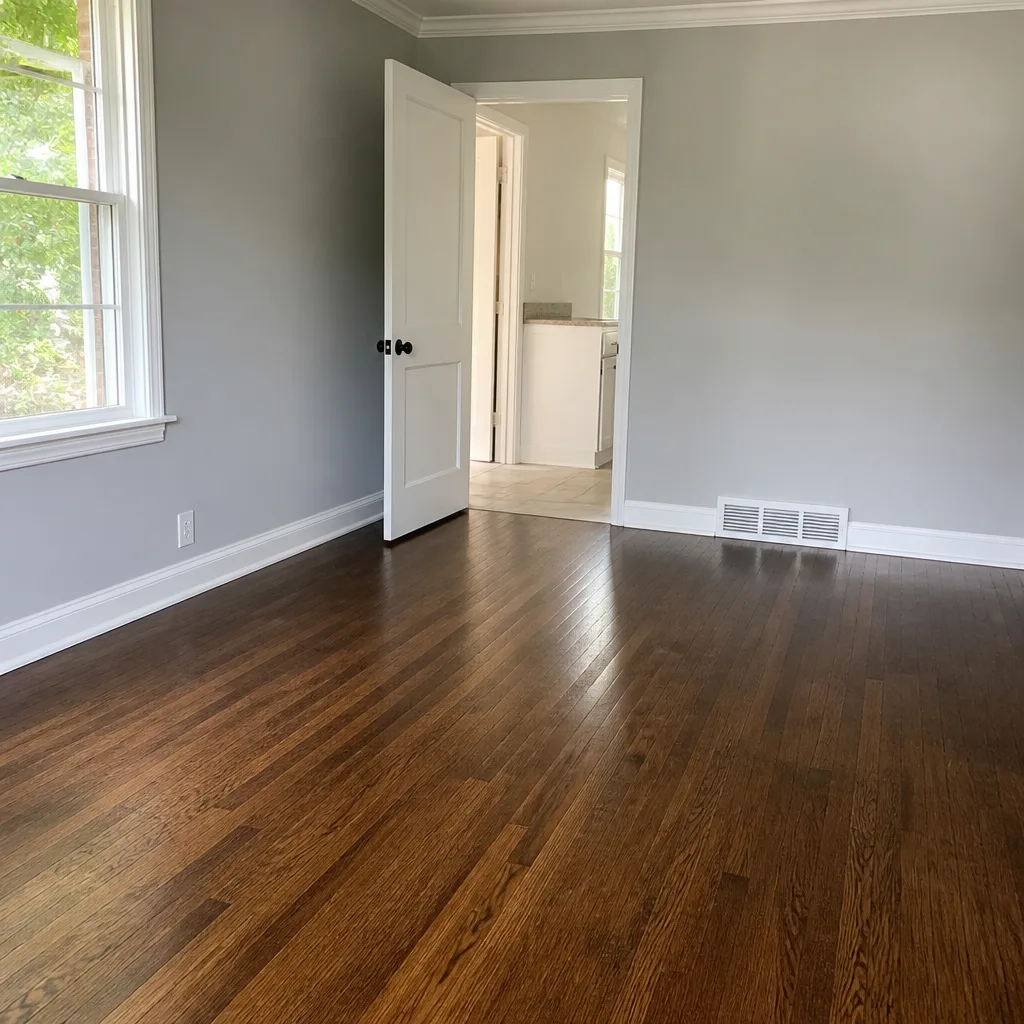
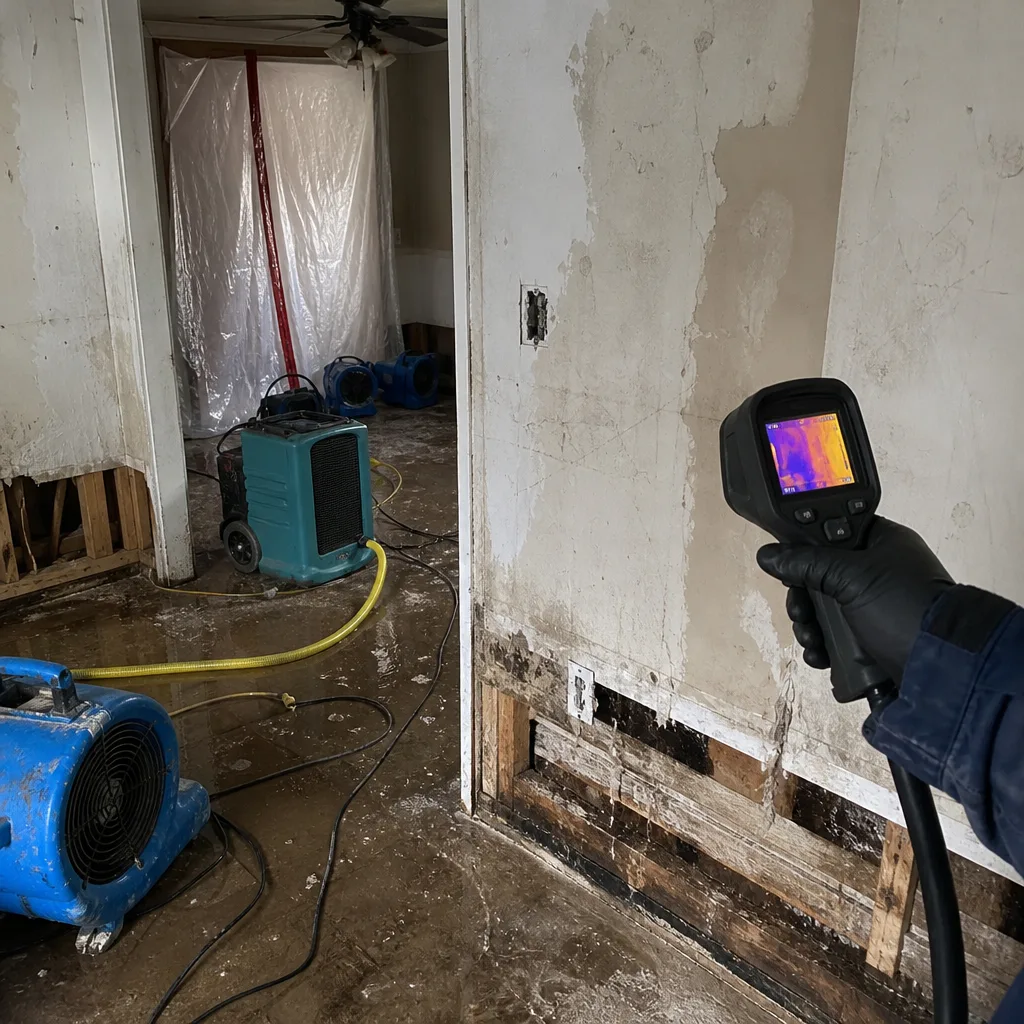 Before
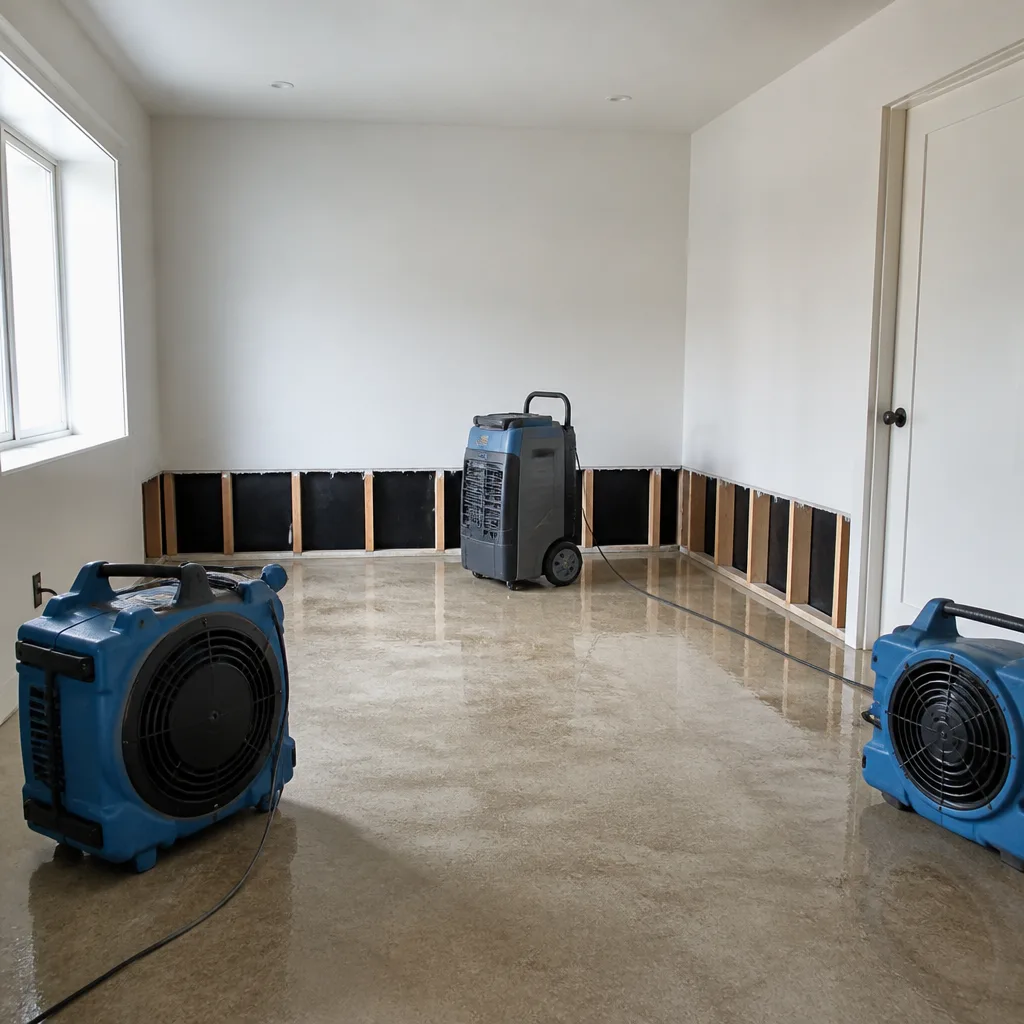 After
After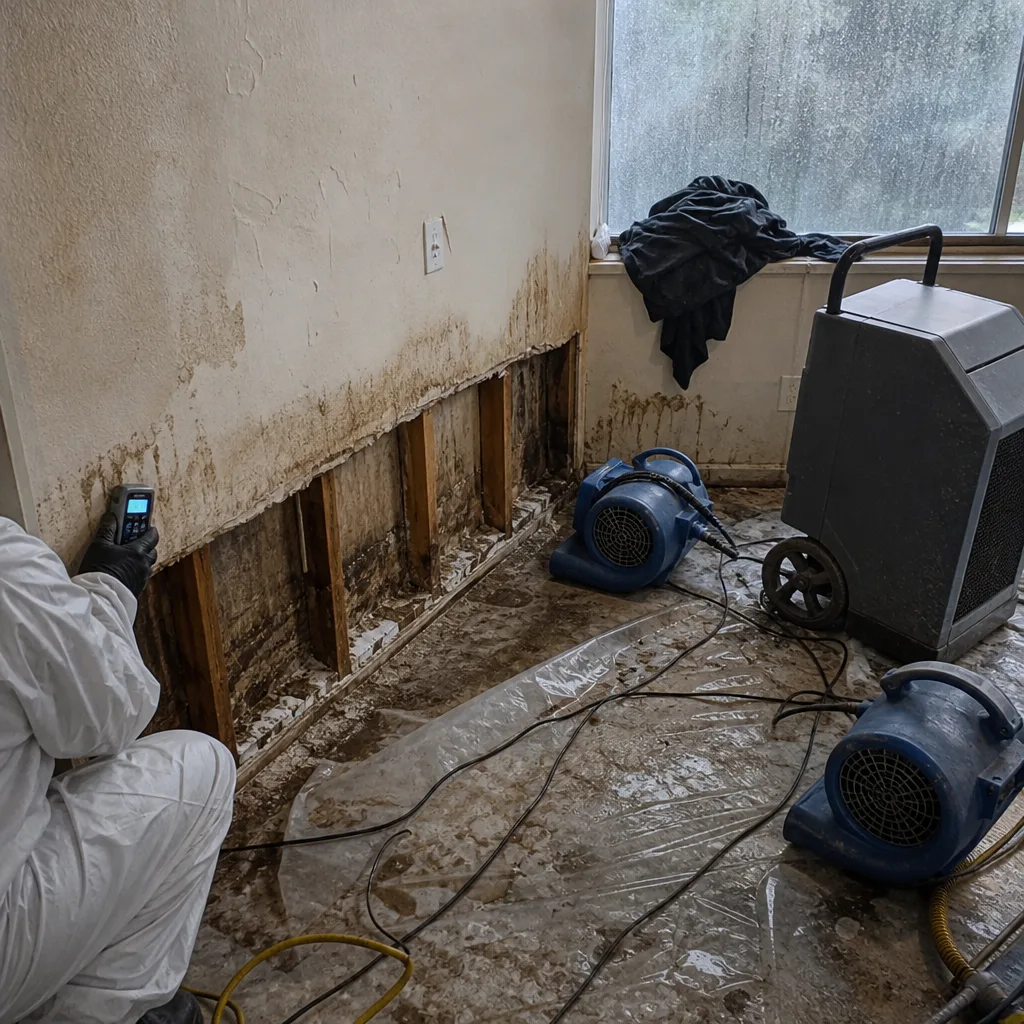 Before
 After
After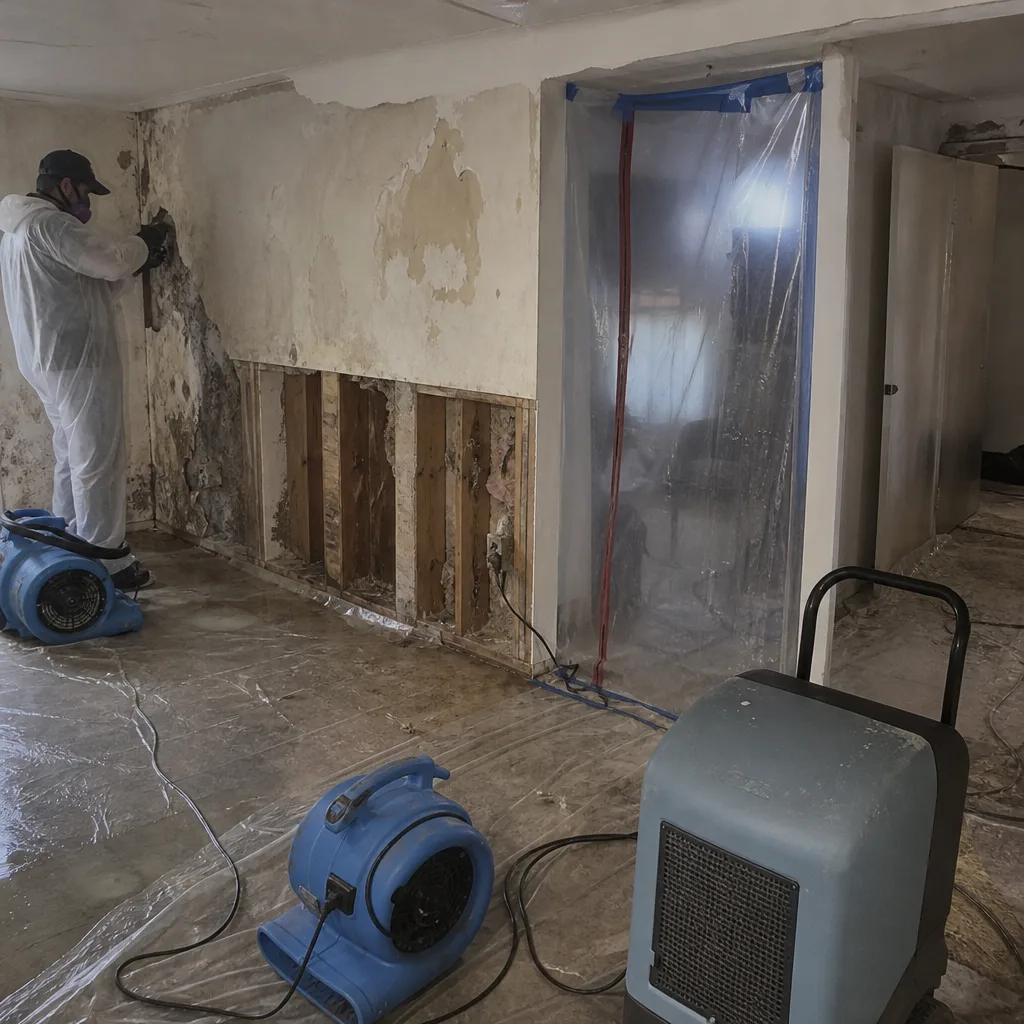 Before
 After
AfterHow Long Does Mold Remediation Take? Timelines and What to Expect
A contractor who tells you Mold Remediation services take “two days” is describing labor hours, not your actual displacement. In Los Angeles, where our mild winters and marine layer create year-round humidity pockets in crawl spaces and wall cavities, the honest timeline for a single-room job runs 7 – 10 days from first call to re-occupancy. That gap between “active work” and “move back in” is where homeowners get stranded in hotels, fighting with adjusters, and wondering why their contractor stopped answering calls. This guide breaks down every phase, the real day counts, and the displacement thresholds that determine whether you can sleep in your own bed tonight.
Quick Answer
Most mold remediation projects in Los Angeles take 7 – 14 days from assessment to clearance clearance, though a contained bathroom job may finish in 5 – 7 days and whole-house HVAC-distributed contamination can stretch past three weeks. The active demolition and treatment portion is typically 2 – 4 days; the remaining time is consumed by mandatory drying windows, antimicrobial dwell times, and laboratory clearance testing that no ethical contractor can rush.
Table of Contents
- The Four Phases of Mold Remediation
- Why the Drying Phase Is Non-Negotiable
- Scenario-Specific Timelines: From Bathroom to Whole House
- Clearance Testing in Los Angeles: Lab Turnarounds and Failed Results
- When You Have to Leave: Displacement Thresholds by Project Type
- How Insurance Adjusters Affect Your Timeline
- Common Mistakes to Avoid
- When to Call a Professional
- Frequently Asked Questions
The Four Phases of Mold Remediation
Every mold job we handle at Keegan Water Damage Restoration home moves through four distinct phases. Contractors who quote short timelines typically count only phase two and hope you do not ask about the rest.
Phase 1: Assessment and Scope (Day 1 – 2)
A technician arrives with moisture meters, thermal imaging, and air sampling equipment to locate the moisture source, map the contamination, and build a written scope of work. In Los Angeles, we frequently find secondary mold colonies in Santa Monica Canyon homes where ocean-facing walls trap salt-laden moisture, or in Mid-Century Modern properties in the Hollywood Hills with flat roofs and inadequate ventilation. This phase includes documenting conditions for your insurance claim with photographs and moisture readings.
The scope specifies containment barriers, negative air pressure requirements, demolition extent, drying equipment placement, and the clearance testing protocol. We put the price in writing before any work starts. That is The Garrison Standard.
Phase 2: Active Remediation (Days 2 – 5)
This is the visible work: erecting polyethylene containment, running HEPA-filtered negative air machines, removing contaminated drywall or insulation, HEPA vacuuming all surfaces, and applying antimicrobial treatments. A single bathroom with surface mold on drywall may take one technician a day. A crawl space in Los Feliz with fungal growth on joists and subflooring may take a crew of three two full days.
The work ends when demolition is complete, surfaces are treated, and the moisture source is eliminated. But the space is not yet habitable.
Phase 3: Drying and Treatment Dwell (Days 3 – 7)
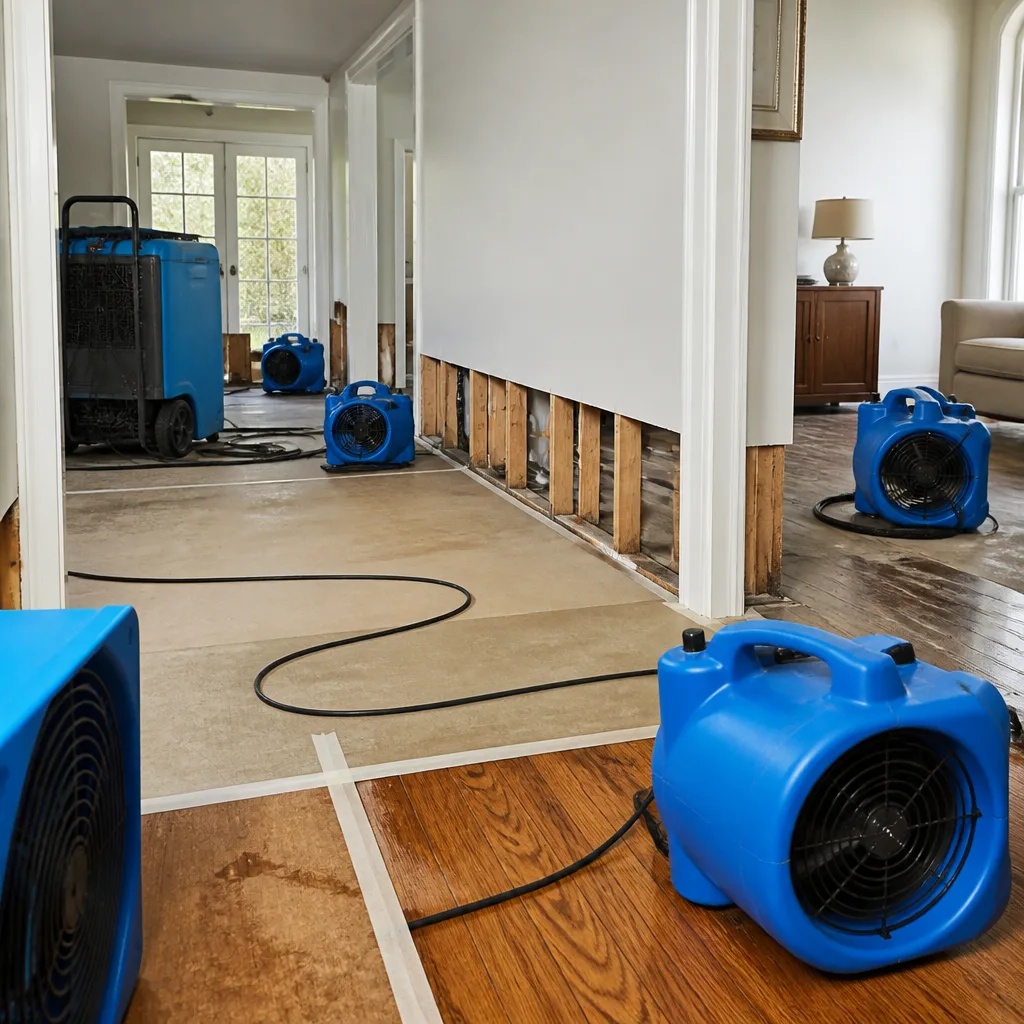
Here is where timelines diverge from contractor promises. Structural materials must reach specific moisture content levels before reconstruction or clearance testing. We deploy professional-grade dehumidification and air movement equipment – in our fleet, that means Dri-Eaz and Phoenix LGR dehumidifiers, XPOWER and B-Air air movers, and Injectidry cavity drying systems for wall voids – and monitor daily with calibrated psychrometric readings.
Antimicrobial treatments require dwell time to penetrate and remain effective. Rushing this phase risks re-growth within weeks. IICRC S520, the industry standard for mold remediation, specifies drying criteria rather than arbitrary day counts.
Phase 4: Clearance Testing (Days 6 – 10)
An independent third-party inspector or industrial hygienist collects air and surface samples for laboratory analysis. In Los Angeles, we typically see 24 – 48 hour turnaround from established labs in Vernon or the San Fernando Valley. The space cannot be re-occupied until results confirm spore counts at or below outdoor baseline levels and no target mold species are detected in amplified quantities.
If the first test fails, the cycle repeats: additional cleaning, extended drying, and re-testing. This is uncommon when the job is scoped and executed properly, but it happens when contractors skip steps or homeowners re-enter prematurely and disturb containment.
Why the Drying Phase Is Non-Negotiable
We have seen contractors in Los Angeles promise same-day or next-day completion for mold jobs. They are either remediating only visible surface growth while leaving saturated cavities untouched, or they are skipping the drying verification entirely. Both approaches fail.
Wood framing in Southern California homes typically holds 9 – 14% moisture content in equilibrium conditions. After a leak or flood, that can spike to 20 – 30%. Mold requires sustained moisture above 16% on wood and 70% relative humidity in air to colonize. Drying targets are not arbitrary; they are the threshold below which biological activity cannot sustain itself.
Our crews use thermo-hygrometers and pinless moisture meters to verify every reading. We log these measurements in your job file, formatted to support your insurance claim. The 365-Day Done Right Promise covers our work for a full year because we do not cut this corner.
Skipping or shortening drying creates three predictable failures:
- Re-growth within 30 – 90 days as residual moisture reactivates dormant spores
- Structural damage as continued high moisture content weakens dimensional lumber and triggers wood-decay fungi
- Failed clearance testing requiring re-remediation, additional displacement, and adjuster disputes over secondary claims
In coastal Los Angeles neighborhoods like Venice or Playa del Rey, where ambient humidity already runs higher, drying takes longer than inland areas like Woodland Hills or Encino. We factor this into every timeline we provide.
Scenario-Specific Timelines: From Bathroom to Whole House
These ranges reflect total elapsed time from initial call to re-occupancy, assuming no clearance test failures. Your specific job may vary based on access, material availability, and insurance authorization.
Bathroom Surface Mold (5 – 7 Days)
Isolated growth on painted drywall or tile grout, moisture source eliminated, no cavity involvement. Assessment and scope on day one, surface remediation and antimicrobial treatment on day two, 48-hour dwell and drying through day four, clearance testing with next-day results. Re-occupancy typically day six or seven.
Displacement: Usually unnecessary if the bathroom can be isolated and ventilated separately.
Single Wall Cavity (7 – 10 Days)
Leak inside one wall, mold on backside of drywall and insulation, limited to one room. Containment and demolition on day two, cavity drying with Injectidry system for 48 – 72 hours, antimicrobial treatment, 48-hour dwell, clearance testing. Common in Los Angeles ranch homes with aging galvanized plumbing in the San Fernando Valley.
Displacement: Required if the room is a bedroom or if HVAC ducts pass through the cavity and may have been compromised.
Crawl Space Contamination (10 – 14 Days)
Fungal growth on floor joists, subflooring, or stem walls. Access limitations slow every phase. Full containment is often impossible, so we seal the subfloor from above and run negative air pressure throughout. Drying is extended because crawl spaces have minimal air exchange. We see this frequently in hillside homes in Silver Lake and Echo Park with inadequate foundation ventilation.
Displacement: Often unnecessary if the living space above maintains normal air quality, though occupants with asthma or immune compromise may choose to relocate during active work.
Multi-Room HVAC-Distributed Contamination (14 – 21+ Days)
The most complex scenario: mold originating in one area, spores distributed through central air conditioning to multiple rooms. Requires full HVAC cleaning and verification, room-by-room remediation, and whole-system clearance. In Los Angeles, where central air runs six to eight months annually and many systems are decades old, this is more common than homeowners expect.
Displacement: Required. The HVAC system cannot be operated during remediation, and multiple containment areas make normal occupancy impossible.
Clearance Testing in Los Angeles: Lab Turnarounds and Failed Results
Clearance testing is the independent verification that remediation succeeded. It is not optional for any job governed by IICRC standards, and it is the gate between “work complete” and “safe to return.”
How Clearance Testing Works
- Visual inspection: No visible mold, dust, or debris; containment materials removed; space clean and dry
- Air sampling: Indoor spore counts compared to outdoor baseline; specific mold species evaluated for amplification
- Surface sampling (if required): Tape lifts or swabs from previously contaminated areas
- Laboratory analysis: Samples cultured or analyzed via microscopy; results interpreted by the inspector
Los Angeles Lab Realities
Most Los Angeles remediation contractors use labs in Vernon, Pacoima, or Torrance with 24-hour turnaround for standard analysis. Rush processing is available at premium cost but rarely justified unless displacement costs exceed the rush fee. We have worked with the same network of independent inspectors for years and coordinate scheduling to avoid gaps.
A failed clearance test means one of three things: residual moisture, incomplete source removal, or post-remediation contamination (typically from someone entering the sealed space). The fix is additional cleaning, extended drying, and re-testing. This adds 2 – 4 days minimum. We have had two failed clearances in the last five years, both traced to plumbing leaks that reactivated after our initial dry-down.
When You Have to Leave: Displacement Thresholds by Project Type
This is the question homeowners ask after the price but before signing: “Do we need a hotel?” The answer depends on contamination extent, HVAC involvement, and occupant vulnerability.
You Can Typically Stay
- Single bathroom with isolated surface mold, door closed, exhaust fan sealed, no HVAC return in the room
- Crawl space or attic work with sealed access and no air exchange with living space
- Exterior wall remediation in a non-essential room, provided containment is intact and negative air is maintained
You Should Leave
- Any bedroom or primary living area under active remediation
- Multiple rooms with concurrent containment
- HVAC system involved, even if only one room shows visible growth
- Occupants with asthma, COPD, immune suppression, or infants under 12 months
- Category 3 water source (sewage backup) where bacterial contamination accompanies mold
In Los Angeles, where short-term rental costs run high and insurance displacement coverage varies, we provide written documentation of our displacement recommendation for your adjuster. Our live dispatch team can also refer you to temporary housing resources we have coordinated with in past claims.
How Insurance Adjusters Affect Your Timeline
Most mold remediation in Los Angeles involves an insurance claim, and the adjuster timeline runs parallel to the physical work. Delays here extend your displacement even when the contractor is ready.
We document every job with photographs, moisture logs, equipment placement records, and written scope of loss. This documentation is formatted specifically for adjuster review. Our experience with Los Angeles-area carriers means we know what documentation prevents back-and-forth: pre-loss condition photos, moisture mapping with date stamps, equipment rental logs, and line-item scope breakdowns.
Common adjuster-related delays include:
- Scope disputes: Adjuster wants to limit demolition; we provide moisture readings proving cavity saturation
- Coverage verification: Mold caps or exclusions require policy review; we document sudden and accidental water origin
- Preferred vendor pressure: Some carriers push their own networks; our documentation supports your right to choose
- Supplement processing: Hidden damage discovered during work requires additional authorization
We do not begin work until the scope and price are agreed in writing, but we will board, extract, or stabilize to prevent further damage while coverage is confirmed. That is The Garrison Code: do it by the book, leave the site clean, stand behind the work.
Common Mistakes to Avoid
- Accepting a timeline that omits drying and testing. A contractor quoting “two days” for a wall cavity job is not describing your return date. Ask specifically: when can we sleep here again?
- Re-entering during the dwell period. We have seen homeowners open containment to “check progress,” introducing spores and requiring re-cleaning. The written scope specifies no-access periods for a reason.
- Hiring based on lowest bid without clearance testing included. The cheap quote often omits independent verification, leaving you with no documentation that the job was done right.
- Ignoring Los Angeles-specific humidity factors. Contractors from drier climates underestimate our marine layer and coastal moisture. Local experience matters for accurate drying projections.
- Starting reconstruction before clearance. We have torn out new drywall because a contractor installed it over damp framing that later failed testing. Reconstruction waits for the green light.
- Not asking about the guarantee. Our 365-Day Done Right Promise includes a free return visit if repair issues emerge. Ask any contractor what happens if mold returns in six months.
When to Call a Professional
Call for assessment when you smell mustiness without visible source, see discoloration spreading beyond a few square feet, experience persistent moisture despite repairs, or have any mold concern following a water loss or leak. Mold Remediation in Los Angeles requires both technical execution and honest timeline communication.
Keegan Water Damage Restoration offers free estimates in Los Angeles. A live person answers every call, 24 hours a day, 7 days a week – including nights, weekends, and holidays. Call (361) 317-7269 to speak with our dispatch team, schedule assessment, and receive a written scope and price before any work begins.
Frequently Asked Questions
A typical single-room job takes 7 – 10 days from assessment to re-occupancy, while multi-room or HVAC-involved projects run 14 – 21 days. The active demolition portion is only 2 – 4 days; the remainder is drying, treatment dwell, and laboratory clearance testing. Call (361) 317-7269 for a timeline specific to your property.
No ethical contractor can complete full mold remediation, including drying verification and clearance testing, in one day. Surface cleaning of visible growth without addressing moisture sources or verifying air quality is not remediation; it is a temporary cosmetic fix that typically fails within weeks.
Most homeowners policies with Additional Living Expense coverage will reimburse reasonable displacement costs when remediation makes the home uninhabitable, though coverage limits and deductibles apply. We document our displacement recommendation in writing to support your claim. Direct adjuster coordination is part of our standard process.
The contractor returns to address the cause, typically additional cleaning or extended drying, then schedules re-testing. This adds 2 – 4 days. Our 365-Day Done Right Promise covers our work for a full year, and we have had only two failed clearances in five years, both traced to subsequent plumbing leaks.
You need to leave if the work affects bedrooms, primary living areas, or your HVAC system, or if occupants have respiratory or immune vulnerabilities. Isolated bathroom or exterior wall work with proper containment may allow you to stay. We provide specific displacement guidance in every written scope.
They are likely counting only active labor hours, omitting mandatory drying windows and clearance testing. In Los Angeles, where our climate extends drying times compared to drier regions, accurate timelines protect you from unexpected displacement and failed verification. Ask any contractor for the specific re-occupancy date, not just the “work done” date.
The Bottom Line
Mold remediation timelines are measured in days, but the honest answer is almost always longer than the initial sales conversation suggests. Explore more guides & resources to help you through every phase of recovery. The four phases – assessment, active work, drying and dwell, clearance testing – each carry non-negotiable minimums. In Los Angeles, our climate, housing stock, and insurance landscape add variables that local experience navigates more accurately than generic promises. The contractor who gives you the longer timeline upfront is the one who will not strand you in a hotel wondering when you can go home.
At Keegan Water Damage Restoration, every job runs to The Garrison Standard: written price before work starts, background-checked uniformed technicians, professional-grade equipment from Dri-Eaz, Phoenix, XPOWER, B-Air, and Injectidry, and the 365-Day Done Right Promise backing every repair. We have been part of the Garrison Partners family since 2005, serving Los Angeles with the discipline that comes from doing it by the book on every single job.
Ready for an honest timeline and a written estimate? Call (361) 317-7269 – a live person answers 24/7, and your assessment is free.
Written by Shane Pruitt, Owner at Keegan Water Damage Restoration, serving Los Angeles since 2005.