
Phoenix Water Damage Restoration in Los Angeles: A Homeowner’s Guide
Phoenix air movers are the most common drying equipment deployed in Los Angeles water damage jobs, but the “one machine per 50 square feet” rule you’ll find online was written for wood-framed homes with vented crawl spaces, not the slab-on-grade stucco construction that dominates LA. In our experience running jobs from Venice to Eagle Rock, placement strategy and electrical planning matter more than raw machine count. If you’re dealing with active water damage right now and don’t want to sort through equipment specs, call us at (361) 317-7269 – a live person answers 24/7, and we can have a crew out with a written scope before any work starts.
Most Los Angeles homeowners have never watched a restoration crew set up. They see fans and plastic tubes and assume the process is roughly the same everywhere. It isn’t. The Phoenix RCP and AXD series units that make up the backbone of professional drying are powerful tools, but their effectiveness depends entirely on whether your technician understands how slab foundations, stucco wall systems, and California’s electrical codes change the math.
Why the “One Air Mover Per 50 Square Feet” Rule Fails in Los Angeles
That 50-square-foot formula comes from IICRC water restoration guidelines developed decades ago in markets where basements and crawl spaces were standard. Los Angeles doesn’t build that way. From the 1960s bungalows in the San Fernando Valley to the concrete-slab condos popping up in Downtown LA and the Arts District, most local homes sit directly on grade with no under-floor ventilation path.
Here’s what changes when there’s no crawl space:
- Moisture can’t escape downward, so it migrates laterally into walls and upward into flooring adhesives
- Stucco exterior walls act like a vapor barrier on the outside, trapping moisture inside wall cavities
- Concrete slabs wick water slowly but hold it for weeks if extraction is incomplete
- Air movers pointed at the floor surface dry the floor – they do nothing for the water trapped in the slab edge or wall base
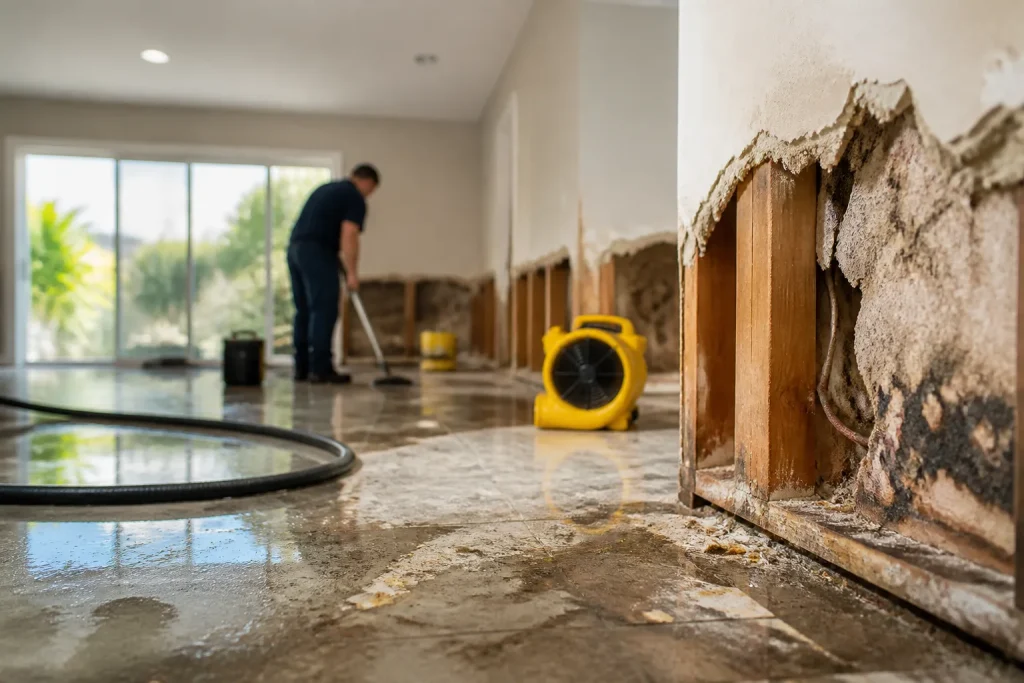
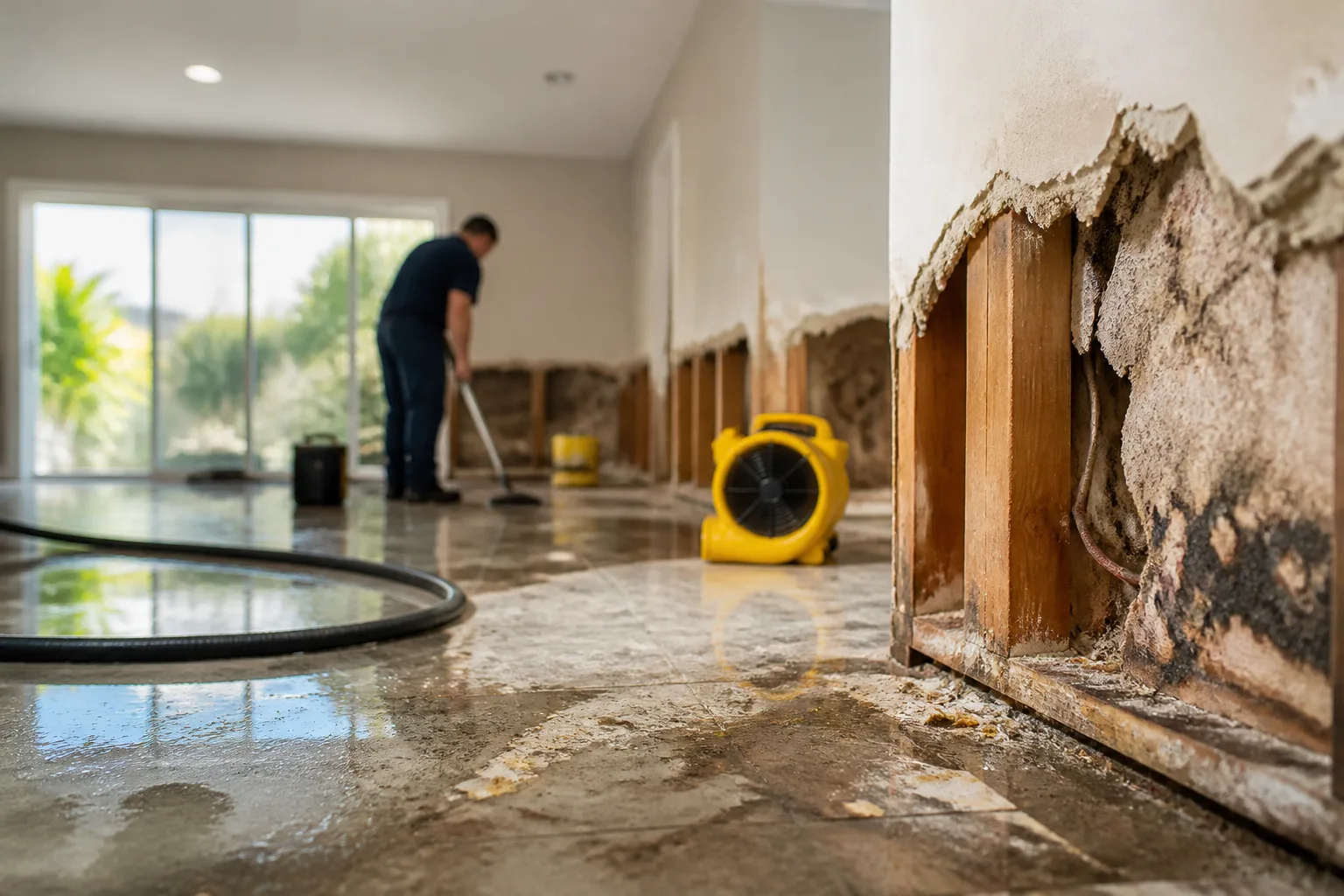
We ran a job last month in a 1970s ranch-style home near LAX where the previous contractor had installed eight Phoenix RCP units using the 50-square-foot rule. The floors felt dry. The moisture meters told a different story: the slab perimeter was still above 17% moisture content, and mold was starting behind the baseboards. The homeowner had paid for drying that looked right but functionally failed. We repositioned the equipment, added targeted wall-cavity drying with Injectidry hose systems, and got the structure to dry standard in four more days. The insurance adjuster only approved the supplemental because we documented every Phoenix serial number and placement on a diagram they could verify.
Phoenix RCP vs. AXD: Axial and Centrifugal Airflow in LA Homes
Phoenix Restoration Equipment builds two main categories of air movers, and the difference matters for your house.
Phoenix RCP series are centrifugal units. They draw air through a fan housing and direct it in a focused, high-velocity stream. Think of them as precision tools. A properly placed RCP unit can push air 15 – 20 feet across a floor surface or drive drying air into a wall cavity when paired with an Injectidry system. In Los Angeles homes with open floor plans – common in post-1990 builds from Sherman Oaks to Culver City – RCP units dry large surface areas efficiently.
Phoenix AXD series are axial units. They move higher volumes of air at lower velocity, more like a traditional fan but with professional airflow ratings. AXD units excel at general air circulation and work best when the goal is mixing air in a room rather than targeting a specific wet surface. We use them in smaller LA bedrooms, hallways, and anywhere the drying plan calls for broad humidity reduction rather than spot drying.
The mistake we see: contractors running all axial or all centrifugal because that’s what they own. A proper drying plan in Los Angeles typically mixes both. RCP units hit the wet walls and floor edges where slab meets stucco. AXD units keep the overall room air moving so dehumidifiers can actually pull moisture out of the air instead of recycling the same humid pocket.
Slab-on-Grade Construction and Equipment Positioning
Los Angeles County building records show slab-on-grade construction dominates residential permits from the 1950s forward, with particular concentration in the San Fernando Valley, South Bay, and Gateway Cities. No crawl space means no natural airflow beneath your floors. Water that hits a slab either pools on top or gets driven into the perimeter wall system.
This changes Phoenix air mover placement in three specific ways:
- Perimeter-first positioning: In a crawl-space home, you’d center air movers to drive air across the subfloor from below. In LA, we position RCP units 12 – 18 inches from exterior walls, aiming airflow along the wall base where slab and stucco meet. That’s where moisture lingers longest.
- Wall cavity access: We often need to remove baseboards or drill small access holes to get drying air inside walls. The Phoenix units don’t do this alone – they work with Injectidry or Dri-Eaz wall cavity systems – but their placement determines whether that targeted airflow actually reaches the wet framing.
- Floor covering removal: In homes with glued-down vinyl or engineered wood over slab, air movers on top of the flooring dry the flooring, not the slab. We make the call on whether partial removal is necessary, and we put that scope in writing before cutting anything.
We’ve documented jobs in Mid-City where the slab was still damp three weeks after “drying” because the previous crew never addressed the perimeter wall system. The homeowner thought they were done. The musty smell told the real story.
Electrical Reality: Daisy-Chaining Phoenix Units in LA Homes
Each Phoenix RCP unit draws roughly 2.9 amps at startup; AXD units run closer to 2.4 amps. A typical residential bedroom in Los Angeles has a 15-amp circuit, often shared with outlets in adjacent rooms. Do the math: four RCP units on one circuit plus a dehumidifier will trip the breaker. We’ve seen it happen.
Professional crews daisy-chain Phoenix units using the built-in outlet on each machine, but this doesn’t reduce total circuit load – it just reduces extension cord clutter. The first unit still carries the cumulative amperage of everything downstream. In older Los Angeles neighborhoods like Highland Park or parts of Long Beach, we regularly encounter knob-and-tube remnants or 60-amp main panels that can’t handle a full drying array without strategic load management.
Before we set up, we map the outlet circuits. We bring commercial-grade 12-gauge extension cords, never the thin orange homeowner cords that overheat under continuous load. If the panel can’t support the equipment plan, we bring a generator or split the array across multiple rooms. This isn’t optional – it’s part of The Garrison Standard. We put the electrical plan in the written scope so there’s no surprise when we need access to the garage or exterior outlet.
Homeowners can help by knowing where their electrical panel is and whether any circuits are already running heavy loads like window AC units or space heaters. Tell your technician before they start plugging in.
Why Air Movers Without Dehumidifiers Just Move Humid Air Around
This is the point where a lot of DIY attempts and cut-rate jobs fall apart. Phoenix air movers accelerate evaporation – they don’t remove moisture from the building. Evaporated water goes into the air. If the air in your Los Angeles home is already humid, and there’s no dehumidifier pulling that moisture out, the air simply re-deposits water on cooler surfaces. You’ve created a humidity loop.
Proper drying requires balancing three factors: airflow (the Phoenix units), temperature, and dehumidification. In LA’s mild climate, we often don’t need supplemental heat, but we absolutely need dehumidification. Professional-grade units from the same equipment families – Phoenix and Dri-Eaz – pull 30 – 130 pints per day depending on the model and conditions.
We calculate dehumidifier capacity using psychrometrics, which is just the study of how air temperature and humidity interact. A technician with a thermo-hygrometer measures the room’s specific humidity, then sizes equipment to hit the drying goal. In coastal Los Angeles neighborhoods like Santa Monica or San Pedro, where ambient humidity runs higher, we upsize dehumidifiers compared to inland Valley jobs. Same square footage, different equipment load.
Running air movers without adequate dehumidification also risks secondary damage. We’ve been called to jobs in Koreatown where a homeowner rented six fans from a hardware store, ran them for a week, and ended up with condensation damage on windows and mold on the ceiling. The fans did their job too well – they evaporated water the room couldn’t evacuate.
What a Properly Documented Phoenix Equipment Log Looks Like
Insurance adjusters in California are increasingly requiring equipment documentation that goes beyond a photo of fans in a room. They want serial numbers, placement diagrams, and runtime logs. We provide all three, formatted to support your claim from day one.
A proper Phoenix equipment log includes:
- Serial number of each RCP or AXD unit deployed
- Date and time placed, date and time retrieved
- Room location with a simple diagram showing unit placement and airflow direction
- Before-and-after moisture readings for each affected material
- Dehumidifier serial numbers and pint-capacity ratings
- Daily psychrometric readings showing progress toward dry standard
This documentation matters for two reasons. First, it proves the drying was done to IICRC standard, which most insurance policies reference. Second, it supports supplemental claims if hidden moisture extends the job. We had a case in Echo Park where the initial scope covered the living room, but thermal imaging revealed water migration into an adjacent closet. Because we had serial-numbered logs and placement diagrams for the original equipment, the adjuster approved the supplemental without dispute – the documentation showed we weren’t padding the bill, we were responding to verified conditions.
Every Keegan job gets this level of documentation. It’s part of how we operate under The Garrison Standard. The Done Right Promise covers the repair work, but the documentation protects you during the claim process.
When to Call a Professional in Los Angeles
If water has affected more than a single small room, if the water sat for more than a few hours, if you suspect it reached wall cavities or a slab edge, or if you smell mustiness after initial cleanup, you need professional assessment. Moisture meters and thermal imaging reveal what surface drying hides. We provide free estimates, and we put the full scope and price in writing before any equipment runs.
Related services in Los Angeles: Water Damage Restoration in Los Angeles | Mold Remediation in Los Angeles
The Bottom Line
Phoenix air movers are excellent equipment, but they’re not plug-and-play. In Los Angeles homes, slab foundations, stucco walls, and California electrical realities change how they should be deployed. The machine count matters less than placement strategy, electrical planning, and pairing with adequate dehumidification. Documentation protects your insurance claim. And a written scope protects you from surprise charges.
Key takeaways:
- The “one air mover per 50 square feet” rule doesn’t account for LA’s slab-on-grade construction
- Centrifugal (RCP) and axial (AXD) Phoenix units serve different drying purposes – proper jobs use both
- Electrical load planning prevents breaker trips and safety hazards
- Air movers without dehumidifiers create humidity loops, not drying
- Serial-numbered equipment logs and placement diagrams support insurance claims and supplementals
If you’re in Los Angeles and dealing with water damage, or if you’ve had a previous drying job that doesn’t feel quite right, call (361) 317-7269. A live person answers 24/7. We’ll assess the situation, explain what we find in plain language, and give you a written price before any work starts.
Frequently Asked Questions
It depends on your construction type, not just square footage. Slab-on-grade homes common in Los Angeles typically need more perimeter-focused placement and often fewer total units than crawl-space homes – but the units must be positioned correctly against exterior walls, not just centered in rooms. A professional assessment with moisture mapping gives the accurate count. Call (361) 317-7269 for a free estimate.
You can rent equipment, but proper drying requires moisture detection tools, psychrometric calculations, and electrical planning that most homeowners don’t have. We’ve been called to dozens of Los Angeles DIY jobs where fans ran for weeks but hidden moisture caused mold or structural damage. We don’t recommend self-drying for anything beyond a small, contained spill on a hard surface. For larger jobs, professional documentation also supports your insurance claim.
Most standard homeowner policies cover sudden and accidental water damage, including professional drying equipment, when the work is documented to industry standard. We format every Keegan job log – Phoenix serial numbers, placement diagrams, daily readings – specifically to support adjuster review. We also coordinate directly with your adjuster when requested. Coverage specifics depend on your policy and the water source; we can review both during our free estimate.
Standard drying takes 3 – 5 days for most residential water damage jobs in Los Angeles, assuming the water was extracted promptly and dehumidification is adequate. Slab-on-grade homes sometimes extend to 5 – 7 days because concrete releases moisture slowly. We verify dryness with moisture meters and thermal imaging, not calendar guesses, and we don’t pull equipment until materials hit IICRC dry standard. Call (361) 317-7269 to schedule assessment and get a realistic timeline for your specific situation.
Written by the team at Keegan Water Damage Restoration.
Need Damage Restoration Help?
Call Keegan Water Damage Restoration - licensed & insured, here with fast after-hours help in Los Angeles.
(361) 317-7269