
Preparing Your Home’s Damage Restoration for Winter in Los Angeles
Preparing your Los Angeles home for winter damage risk means inspecting four specific failure points before the first major rain: flat roof membrane seams, seasonal plumbing traps, stucco cracks at window penetrations, and aging galvanized supply lines. Most LA homes sit untested by rain for six to eight months, so the first storm of the season often reveals problems that developed silently through the dry summer. If you’d rather have a professional assess your home before the rains hit, call us at (361) 317-7269 – we offer free estimates and put the scope in writing before any work starts.
Here’s the thing most Los Angeles homeowners miss: our winters are mild, but that mildness is exactly what creates concentrated risk. The average LA home goes six to eight months between meaningful rainfall. Pipe joints dry out. Roof penetrations crack and shift. Stucco separates from window frames. Then the first hard rain of the season – often a December or January El Niño event – hits a structure that hasn’t been tested since February. That’s not mild weather risk. That’s deferred exposure, and it overwhelms restoration crews across Los Angeles every winter.
Why Los Angeles Winter Damage Catches Homeowners Off Guard
We’ve been running water damage restoration jobs in Los Angeles, and the pattern repeats every November. Homeowners who spent the summer worrying about earthquakes and wildfires suddenly discover their roof leaks, their laundry room floods, or their crawl space has been harboring mold since a March storm they never properly dried out.
The specific challenge in Los Angeles is our Mediterranean climate pattern. Eight months of dry, warm air bakes materials that were never designed for that cycle. Rubber roof membranes oxidize and seam adhesive fails. Galvanized steel supply lines in pre-1970s homes corrode from the inside where you can’t see it. P-traps under guest bathroom sinks evaporate completely, breaking the seal that keeps sewer gas out and allowing dry air to crack rubber washers.
Then the atmospheric river arrives. In January 2023, we responded to a call in the Hollywood Hills where a homeowner had ignored a softball-sized blister in their torch-down roof membrane through all of October. By mid-December, that blister had cracked. By New Year’s, water had traveled down a rafter bay, across a ceiling joist, and out through a light fixture in the dining room. The insurance adjuster’s first question: “When did you first notice the roof condition?” The homeowner had no documentation. The claim was disputed for six weeks.
This is why we tell Los Angeles homeowners: winter preparation isn’t about the storm. It’s about the eight months before it.
The Four Highest-Failure Points in LA Homes Before Winter Rains
After nearly two decades of winter damage calls across Los Angeles, we’ve identified four failure points that account for the majority of preventable water intrusion. Inspect these in October, or have a professional document them for you.
Flat roof membrane seams. Los Angeles has thousands of mid-century homes with flat or low-slope roofs – from Mid-Century Moderns in the hills to apartment blocks in Koreatown. The torch-down or modified bitumen membranes on these roofs expand and contract through our hot summers. By October, seams have often worked loose or adhesive has crystallized. Water doesn’t enter at the seam itself; it travels laterally underneath the membrane until it finds a penetration – a vent pipe, a skylight curb, an HVAC platform – then drops into the structure. A visual inspection from the street won’t catch this. You need to walk the roof or hire someone who will.
P-trap evaporation in seasonal-use fixtures. That guest bathroom that nobody used all summer? The water seal in its P-trap has likely evaporated. This does two things: it allows sewer gas into the home, and it breaks the hydraulic barrier that prevents drain line airflow from pulling moisture into wall cavities. In older Los Angeles homes with cast iron drain lines, this also accelerates corrosion at the waterline. Run water through every fixture for thirty seconds before the first rain. It’s a two-minute task that prevents a two-thousand-dollar mold remediation.
Stucco cracks at window penetrations. Los Angeles stucco is applied over wire lath on wood framing, and the expansion coefficients don’t match. After a hot summer, the interface between stucco and window frames has often opened a hairline crack. These cracks are invisible from inside the home. Water hits the stucco, migrates through the crack, and runs down the rough opening into the wall cavity. We’ve opened walls in Silver Lake homes where the interior drywall looked perfect but the framing behind it was black with mold from three seasons of this exact pattern. Check the exterior with a flashlight at a low angle – the raking light will show cracks that direct sunlight hides.
Corroded galvanized supply lines in pre-1970s homes. Los Angeles built heavily through the 1950s and 1960s with galvanized steel water supply lines. These corrode from the inside, narrowing the bore and weakening the pipe wall. The first pressure spike of winter – often from thermal expansion when a cold front hits – blows out a pinhole or splits a fitting. We see this most in homes that still have original lines in crawl spaces or slab perimeter areas where the pipe is cold-soaked by winter air. If your home has galvanized supply lines and they’re original, budget for replacement. A mid-winter pipe failure in a slab-on-grade Los Angeles home means jackhammering concrete while it’s raining.
What a Pre-Winter Plumbing Inspection Should Actually Cover
A visual-only plumbing check misses the failure modes that matter. Here’s what we recommend Los Angeles homeowners request, or perform themselves if they’re comfortable accessing these areas:
- Pressure test the supply system. Static pressure should read 40 – 80 PSI on a gauge attached to a hose bib. Pressure over 80 PSI strains aging pipes; pressure that drops when no fixtures are running indicates a leak. Many Los Angeles homes have pressure regulators that failed years ago.
- Inspect water heater T&P valve discharge. The temperature and pressure relief valve on your water heater should have a visible discharge pipe terminating near the floor. If it’s missing, corroded, or discharging intermittently, the tank is experiencing overpressure events that stress connected piping.
- Check washing machine supply hoses. Rubber hoses older than five years should be replaced with braided stainless. We’ve responded to Los Angeles calls where a rubber hose burst during a load of laundry while the homeowner was at work – six hours of unrestricted flow through a 3/4-inch line.
- Verify sump pump or perimeter drain function. Homes in the San Fernando Valley or near the Los Angeles River basin often have perimeter drainage that hasn’t run since March. Pour five gallons into the sump pit and confirm the pump activates, discharges, and shuts off. A failed pump discovered during a storm is a foundation flood.
- Inspect the main sewer cleanout. Remove the cap and look for standing water or roots. Los Angeles’s mature tree canopy – especially ficus and magnolia – sends roots into sewer lines through the slightest separation. A partially blocked line backs up faster when winter rain infiltrates through cracked pipe sections.
If any of these checks reveal concerns, we document the findings with photos formatted to support your insurance claim if a winter failure occurs. That’s part of The Garrison Standard we work to on every job.
How to Document Pre-Existing Conditions Before Storm Season
Insurance claims on storm damage get disputed when adjusters can’t distinguish pre-existing wear from storm-caused damage. The solution is baseline documentation you create in October, before any storm occurs.
Walk the exterior of your Los Angeles home with your phone’s video running. Narrate what you see: “October 15th, no visible cracks at the master bedroom window. Roof membrane appears intact at the skylight.” Capture close-ups of roof penetrations, stucco-to-window interfaces, and any areas where previous repairs were made. Store these in cloud backup, not just on the device.
Inside, photograph ceilings and walls in rooms below roof penetrations or plumbing walls. Run water in every fixture and video the drain flow rate. If a winter clog develops, you have proof the line was clear in October.
For homes with previous water damage, document the completed restoration. Insurance adjusters in Los Angeles see thousands of claims where mold “discovered” in January was actually incomplete drying from a March leak. The local pros photo-document every water damage restoration in Los Angeles with moisture meter readings, drying equipment placement, and final clearance photos. If we did the original work, we have that file. If another contractor did, request their documentation now – many small operators don’t keep records past six months.
This documentation takes twenty minutes and saves twenty hours of claim negotiation.
Why LA Winter Restoration Jobs Present Unique Technical Challenges
When water intrusion does occur in a Los Angeles winter, the restoration process differs from summer jobs in ways that affect drying time and equipment selection.
Higher ambient relative humidity. Los Angeles winter humidity runs 60 – 75% during rain events, compared to 40 – 50% in summer. This slows evaporative drying. The local pros compensate with LGR dehumidifiers – we run Phoenix and Dri-Eaz units sized to the affected cubic footage – and we monitor psychrometric conditions with calibrated sensors, not guesswork. The goal is achieving equilibrium moisture content in structural materials, not just surface dryness.
Limited exterior evaporation. In summer, we can open windows and create cross-ventilation that accelerates drying. In winter, rain and cool temperatures keep windows closed. This forces reliance on mechanical dehumidification and heat injection. For enclosed wall cavities, we use Injectidry systems that deliver conditioned air directly into the void space. Without this equipment, a Los Angeles winter wall cavity can stay wet for weeks.
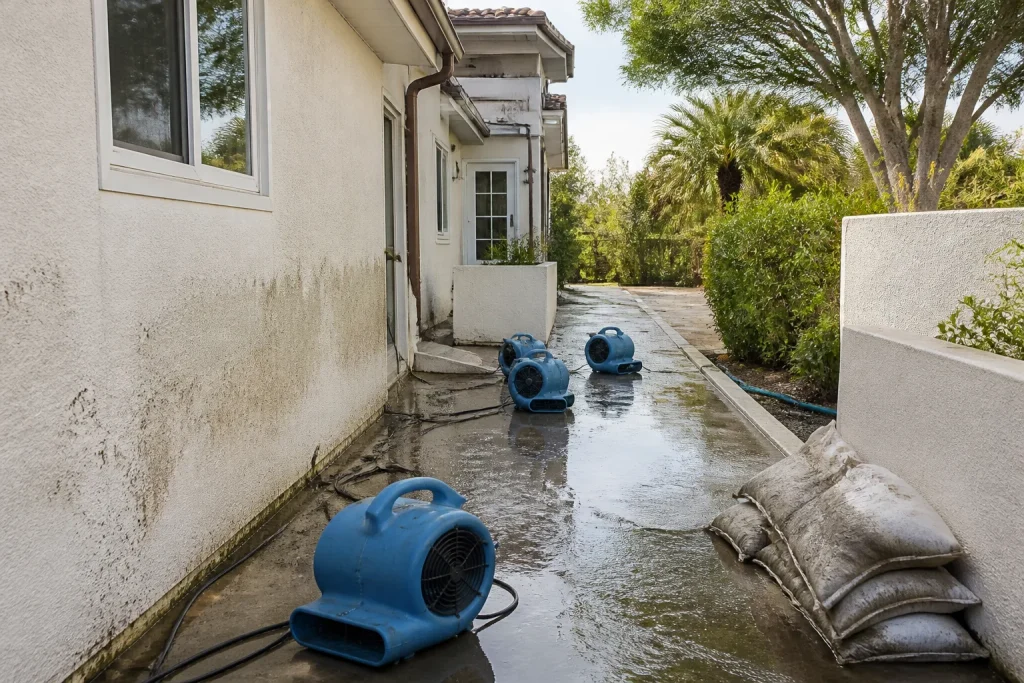
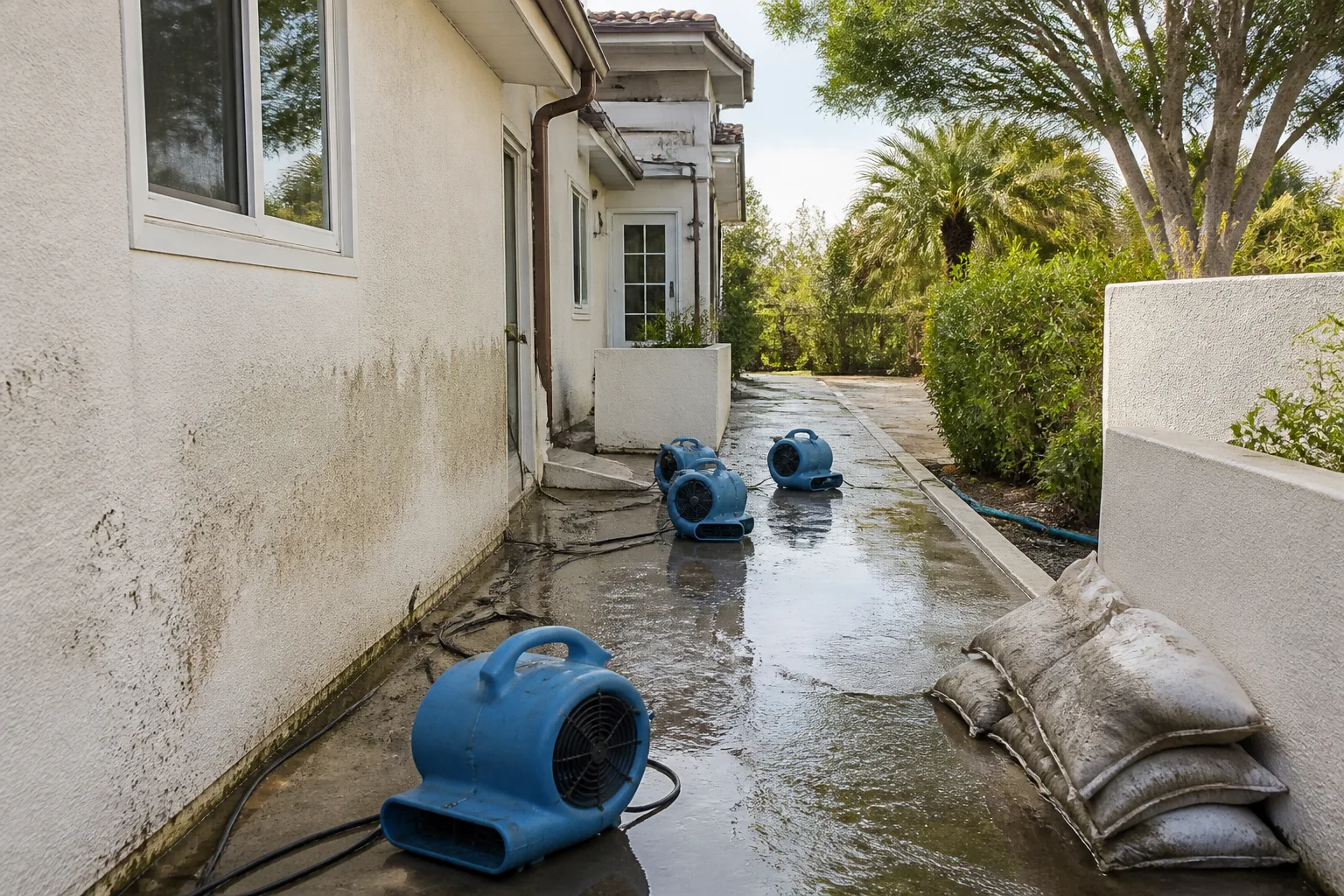
Clay soils and foundation drainage. Much of Los Angeles sits on expansive clay soils that swell when wet and shrink when dry. After eight months of desiccation, these soils are cracked and permeable. The first sustained rain saturates them quickly, and surface water flows toward foundations rather than percolating downward. We’ve seen homes in the Hollywood Hills where hillside runoff entered through foundation vents that were perfectly adequate in summer but submerged during a January storm. Temporary sandbagging and active sump operation are often necessary while permanent drainage improvements are scoped.
These conditions mean winter water damage in Los Angeles takes longer to dry and requires more aggressive equipment deployment. A contractor who quotes summer drying timelines for a winter job doesn’t understand the local conditions.
A Concrete Timeline: What to Do and When
Here’s the schedule we recommend for Los Angeles homeowners, based on two decades of watching the same preventable damage repeat.
October: Inspect and remediate.
- Walk the roof or hire a roofer to document membrane condition
- Seal stucco cracks with elastomeric caulk rated for exterior use
- Replace washing machine hoses and test pressure regulator
- Run water through all fixtures, verify P-traps hold water
- Test sump pump and perimeter drain function
- Document everything with dated photos and video
- Schedule replacement of galvanized supply lines if original to pre-1970s home
November: Prepare temporary protective measures.
- Purchase sandbags or flood barriers for foundation vents and garage entries
- Confirm your homeowner’s policy covers sewer backup and sump pump overflow – many Los Angeles policies exclude these without a rider
- Program our number, (361) 317-7269, into your phone with a note: “Water damage – Keegan, live person 24/7”
- Locate your main water shutoff and practice closing it; if it’s seized, replace the valve now
- Stock a basic emergency kit: tarps, buckets, wet/dry vacuum, moisture meter if you’re technically inclined
December through March: First hour after discovery.
When you find water intrusion during a storm – a ceiling stain, a dripping light fixture, water pooling in a closet – the first hour determines the scope of restoration.
- Stop the source if safely possible: shut off the main for plumbing leaks, tarp the roof penetration if accessible
- Remove standing water with whatever you have – wet/dry vacuum, towels, mopping
- Move furniture and belongings from the wet area; aluminum foil under furniture legs prevents stain transfer
- Document with photos before anything dries or is moved for restoration
- Call (361) 317-7269 – a live person answers, and we dispatch background-checked, uniformed technicians with Phoenix and Dri-Eaz equipment
Do not wait for the rain to stop. Water travels horizontally in wall cavities and down through subflooring. Every hour of delay expands the affected area. We’ve arrived at Los Angeles homes where a simple roof leak discovered at 8 PM became a ceiling collapse by morning because the homeowner “wanted to see how bad it got.”
When to Call a Professional
Some winter preparation is within reach of a capable homeowner. Roof work, pressure testing, and supply line replacement generally aren’t. If you’re uncomfortable on a ladder, don’t own a pressure gauge, or your home has original galvanized plumbing, call a professional for the inspection phase. The cost of a written scope and estimate – ours are free – is negligible against the cost of a mid-winter emergency call.
We also recommend professional assessment for any home with previous water damage, mold history, or insurance claim complications. Our documentation standards mean if a winter failure does occur, your claim is supported from the first phone call.
Related services in Los Angeles: Water Damage Restoration in Los Angeles, Fire Damage Restoration in Los Angeles, Mold Remediation in Los Angeles.
The Bottom Line
Los Angeles winter damage isn’t about extreme weather. It’s about the gap between our long dry season and our concentrated rainy season, and how that gap degrades building materials that go untested for months. The homeowners who fare best are the ones who inspect four specific failure points in October, document their home’s condition before any storm, and know exactly who to call when water appears.
At Keegan Water Damage Restoration, we’ve been part of the Garrison Partners family. We answer calls with a live person 24 hours a day, dispatch background-checked and uniformed technicians, and put every price in writing before work starts. Every repair is backed by our Done Right Promise – if it fails within one year, we return and make it right at no charge. If you’re in Los Angeles and want a professional pre-winter assessment, call (361) 317-7269. Estimates are free, and the scope is always in writing.
Frequently Asked Questions
Standard policies cover sudden and accidental water damage from storm intrusion or burst pipes, but exclude gradual leaks, sewer backup, and sump pump failure unless you’ve purchased specific riders. Documentation of pre-existing conditions strengthens your claim significantly – adjusters dispute damage they can’t date. Call (361) 317-7269 and we can review your situation; estimates are free.
Response times stretch during major events because demand spikes across the region. At Keegan Water Damage Restoration, we maintain 24/7 live dispatch and prioritize active water intrusion calls over non-emergency assessments. The key is calling immediately upon discovery – waiting until morning turns a contained leak into a multi-room mitigation. Save (361) 317-7269 now so you’re not searching during the storm.
Mold doesn’t need warmth – it needs moisture, organic material, and time. Los Angeles winter conditions provide all three: rain introduces moisture, closed windows reduce air exchange, and indoor heating creates temperature differentials that drive condensation in wall cavities. A leak that would dry in 48 hours during a breezy July can sustain mold growth for weeks in January. We address this with controlled drying using Dri-Eaz and Phoenix dehumidifiers, not just fans.
Surface water you can see is rarely the full problem. Water travels through subflooring, into wall cavities, and down structural members where it can’t be mopped up. Without moisture mapping, thermal imaging, and professional-grade dehumidification, hidden moisture sustains mold and degrades structural materials. The local pros use XPOWER air movers and Injectidry cavity drying systems to reach what DIY cleanup misses. For small, contained spills on hard surfaces, DIY may suffice. For anything involving drywall, carpet, or unknown travel paths, professional assessment protects your home’s value and your family’s health.
Written by the team at Keegan Water Damage Restoration.
Need Damage Restoration Help?
Call Keegan Water Damage Restoration - licensed & insured, here with fast after-hours help in Los Angeles.
(361) 317-7269