
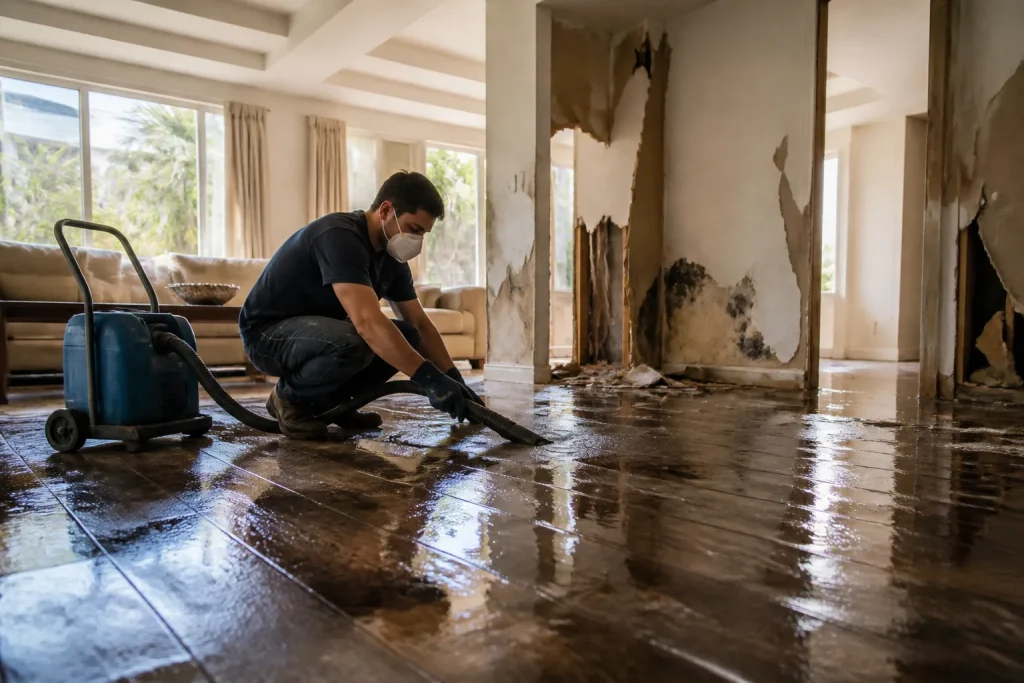
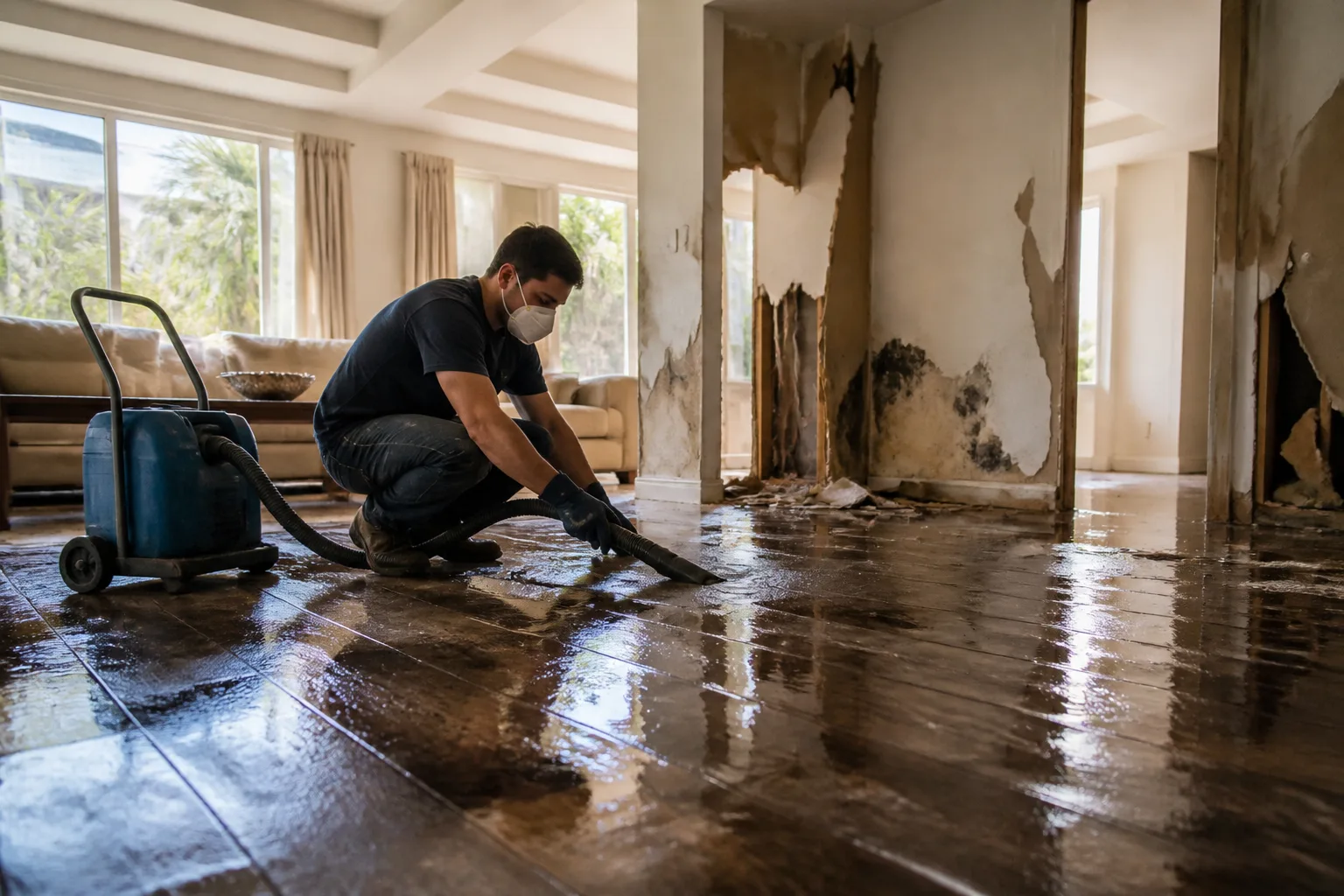
Water Damage Restoration What It Really Costs: What Los Angeles Homeowners Pay in 2026
Water damage restoration in Los Angeles typically runs $3,200 – $8,500 for an average residential job in 2026, with Category 1 clean-water jobs starting around $2,800 and Category 3 black-water losses exceeding $12,000 when structural drying and reconstruction are involved. Most Los Angeles homeowners see final invoices land 15 – 30% above the initial phone estimate because contractors bury equipment day-rates, project management fees, and antimicrobial markups in the scope escalation clause. If you’d rather not parse line-item invoices while your subfloor is still wet, call us at (361) 317-7269 – we put the full scope and price in writing before any equipment touches your home.
The gap between the lowest and highest quotes for the same water damage job in Los Angeles regularly runs 40 – 60%, and it’s rarely explained by quality differences. It’s explained by line items that either are or aren’t in the scope of work. One contractor quotes extraction and drying; another quotes extraction, drying, contents manipulation, antimicrobial application, air scrubber rental, project management, and a 20% overhead-and-profit add-on that only appears after you’ve signed. Same house, same water, wildly different numbers. Here’s how to read the invoice before it becomes your invoice.
How Water Damage Categories Drive Cost in Los Angeles
Restoration pricing starts with the water source, not the square footage. The IICRC categorization system determines safety protocols, disposal requirements, and equipment intensity – and in Los Angeles, where disposal fees at county transfer stations have climbed steadily, the category multiplier is sharper than most homeowners expect.
Category 1 – Clean Water (broken supply line, ice maker, rainwater): $2.80 – $4.50 per square foot. A 1,200-square-foot affected area in a Los Angeles bungalow typically lands at $3,400 – $5,400. Drying takes 3 – 5 days with standard LGR dehumidifiers and axial air movers.
Category 2 – Gray Water (dishwasher, washing machine, sump pump): $4.00 – $6.50 per square foot. The jump isn’t just antimicrobial spray; it’s the padded and porous materials that must go. In our experience across Los Angeles, gray water jobs average $5,200 – $7,800 because carpet pad, baseboard, and lower drywall sections get removed rather than dried in place.
Category 3 – Black Water (sewage, seawater intrusion, rising floodwater): $7.00 – $12.00+ per square foot. Everything porous is removed. HVAC ducting may need cleaning or replacement. In flood-prone pockets of Los Angeles near the Ballona Wetlands or along certain canyon drainage paths, we’ve seen Category 3 losses hit $14,000 on modest 1,400-square-foot homes because of contaminated crawl space soil requiring excavation and barrier replacement.
Category 3 also triggers stricter documentation for your insurance claim. Every removed item gets photographed, every moisture reading gets logged, and the drying plan gets submitted to your adjuster in a format that matches Xactimate pricing structures. That’s standard at Keegan – we don’t charge extra for carrier-formatted documentation, but many Los Angeles contractors do.
The Line Items That Inflate Your Invoice
Here’s where the 40 – 60% quote gap lives. These four line items appear on most Los Angeles restoration invoices, and their pricing is where contractors build margin into ambiguity:
- Equipment day-rates: A Phoenix 200 HT dehumidifier or Dri-Eaz Revolution might rent to a contractor for $35 – $50 per day. The invoice rate to you? Often $85 – $150 per day, per unit. A four-unit, five-day job can carry $1,700 – $3,000 in equipment charges alone. Ask whether the rate is flat or daily, and whether units get pulled once drying goals are met or whether they sit until the end of a standard “monitoring period.”
- Project management fees: 10 – 20% of total job cost, sometimes labeled “supervision” or “coordination.” In Los Angeles, where permit coordination with LADBS or county building departments adds steps, this fee can be justified – but only if someone is actually managing permits, inspectors, and subcontractor schedules. Ask for the specific duties covered.
- Contents manipulation: Moving furniture, boxing personal items, storing them off-site. Los Angeles storage costs run high – $250 – $400 per month for a small pod or vault. Some contractors bill manipulation at $75 – $125 per hour with 4-hour minimums. We’ve seen $900 charges to move a sofa and three boxes out of a flooded living room in Mid-City.
- Antimicrobial application markups: The product costs $8 – $15 per gallon. The application charge? Often $0.50 – $1.25 per square foot. On a 2,000-square-foot job, that’s $1,000 – $2,500 for materials that cost the contractor under $100. It’s necessary work on Category 2 and 3 losses, but the markup deserves scrutiny.
At Keegan Water Damage Restoration, we itemize every charge in the written scope before work starts. No escalation clause, no post-authorization add-ons. That’s The Garrison Standard we’ve run to.
Why Los Angeles Pricing Runs Above National Averages
Generic cost guides citing $2,500 – $5,000 for water damage restoration are using national composites that don’t survive contact with Los Angeles economics. Four local factors push our market structurally higher:
Labor costs: Certified water damage technicians in Los Angeles earn $28 – $42 per hour, versus $18 – $26 in Phoenix or Dallas. IICRC-certified crew leads with WRT and ASD credentials command premiums. The trade is specialized – psychrometrics, moisture mapping, structural drying science – and the talent pool is thin.
Permit and inspection fees: LADBS permitting for reconstruction following water damage runs $400 – $1,200 depending on the scope. If electrical or plumbing was affected, separate permits add cost and timeline. Some contractors absorb this; most pass it through with markup.
Disposal and environmental fees: Los Angeles County transfer stations charge $65 – $95 per ton for construction debris, with additional fees for contaminated materials. Category 2 and 3 debris requires manifesting and sometimes hazardous materials handling. A full gut of water-damaged drywall, insulation, and flooring from a 1,500-square-foot home can generate 6 – 10 tons.
Equipment logistics: Dense neighborhoods from Silver Lake to San Pedro mean parking restrictions, elevator coordination in multi-unit buildings, and sometimes after-hours delivery surcharges. A job that takes 45 minutes to mobilize in suburban Houston takes 2 hours in Los Angeles traffic.
We pulled a job out of a garage over in Echo Park last month where the equipment truck couldn’t park within 200 feet of the building. Extra hose runs, extra labor, extra time – all of it ended up in the scope, but at least the homeowner saw it in writing before we started.
Insurance Direct-Billing vs. Paying Out of Pocket
The invoice your contractor submits to your insurance carrier often looks different from what a self-pay customer would see. This isn’t necessarily fraud; it’s structural.
Insurance billing uses Xactimate pricing, which is updated quarterly and regionally adjusted for Los Angeles. Xactimate rates for water mitigation are typically 15 – 25% higher than cash-market rates because they account for overhead, profit, and the administrative burden of carrier documentation. A contractor billing your carrier directly may show a $6,800 invoice where a cash customer would have paid $5,200 for identical work.
Here’s what changes:
- Overhead and profit (O&P): Xactimate often applies 10% overhead plus 10% profit on jobs with three or more trades. Cash customers rarely see this broken out; it’s embedded in the lump sum.
- Depreciation: Your carrier may depreciate non-structural items – carpet, pad, baseboard – paying actual cash value rather than replacement cost until you complete repairs and submit documentation.
- Code upgrade coverage: If your 1970s Los Angeles home needs updated electrical or plumbing to meet current code, your policy may or may not cover the upgrade. The contractor bills it; the adjuster denies it; you get stuck in the middle.
We document every job to support your insurance claim – photo logs, moisture readings, drying logs, equipment serial numbers – because the cleaner your documentation, the faster your adjuster approves. But we also explain, in writing, what your policy is likely to cover versus what falls to your deductible. No surprises at the end.
When to call a pro: If water has reached subflooring, if you smell mustiness after 48 hours, or if the source was anything other than a clean supply line you controlled immediately. Secondary damage – mold, structural rot, electrical corrosion – multiplies fast in Los Angeles’s warm climate.
Three Questions to Ask Before Signing Any Authorization
These questions expose scope gaps and hidden escalation clauses. Any contractor who won’t answer them in writing before work starts is building in ambiguity:
- “Will the written scope include maximum equipment day-rates, and will units be removed once drying goals are met?” This prevents the five-day job that stretches to twelve because “we’re being conservative.” We specify target equilibrium moisture content – typically 12 – 16% for wood framing in Los Angeles – and pull equipment when we hit it.
- “Are project management fees fixed or percentage-based, and what specific tasks do they cover?” If it’s 15% of whatever the job becomes, that’s an incentive to expand the job. Fixed fees align interests.
- “If my insurance denies a line item, am I responsible for the balance, or does your contract cap my out-of-pocket at the deductible plus any explicitly excluded items?” This is where homeowners get destroyed. The contractor bills $8,000; the carrier pays $5,500; you get a $2,500 surprise. Our written scope at Keegan specifies your maximum exposure before we start.
Related services in Los Angeles: Water Damage Restoration in Los Angeles, Fire Damage Restoration in Los Angeles, Mold Remediation in Los Angeles.
The Bottom Line
Los Angeles water damage restoration in 2026 rewards informed homeowners. The category of water, the transparency of line-item pricing, and the structure of your insurance coverage matter more than the contractor’s brand name or the size of their truck fleet. Expect $3,200 – $8,500 for typical residential losses, with Category 3 and reconstruction jobs running higher. Demand written scopes, capped exposure, and equipment rates tied to measurable drying goals – not open-ended rental periods.
At Keegan Water Damage Restoration, we put the price in writing before any work starts. No escalation clauses, no post-authorization add-ons. Every repair is backed by our Done Right Promise: if it fails within one year, we return and make it right at no charge. Calls are answered by a live person, 24 hours a day, including nights, weekends, and holidays.
If you’re in Los Angeles and need help assessing water damage, call (361) 317-7269 for a free estimate.
Frequently Asked Questions
Most Los Angeles homeowners pay $3,200 – $8,500 for residential water damage restoration in 2026, with Category 1 clean-water jobs starting near $2,800 and Category 3 black-water losses exceeding $12,000 when reconstruction is needed. Category 2 gray-water jobs typically fall in the $5,200 – $7,800 range. Call (361) 317-7269 for an exact quote – estimates are free.
Homeowners insurance typically covers sudden and accidental water damage from burst pipes or appliance failures, but excludes slow leaks, flooding, and sewer backup unless you carry separate riders. The contractor’s invoice format matters – carrier-formatted documentation with photo evidence and moisture logs speeds approval. We coordinate directly with adjusters on every Los Angeles job we handle. Call (361) 317-7269 to discuss your specific policy.
The 40 – 60% quote gap comes from line-item opacity. One contractor quotes extraction and drying only; another adds project management fees, contents manipulation, antimicrobial markups, and open-ended equipment rentals. Always request an itemized written scope before authorizing work. At Keegan, we show every charge upfront – no exceptions.
For active water intrusion, we dispatch background-checked, uniformed technicians as quickly as Los Angeles traffic and job-queue sequencing allow – typically within 1 – 2 hours for emergencies. Speed matters because mold colonization begins in 24 – 48 hours in our climate. Call (361) 317-7269 and a live person will coordinate timing directly.
Written by the team at Keegan Water Damage Restoration.
Need Damage Restoration Help?
Call Keegan Water Damage Restoration - licensed & insured, here with fast after-hours help in Los Angeles.
(361) 317-7269